


IP to Residential Proxy Database
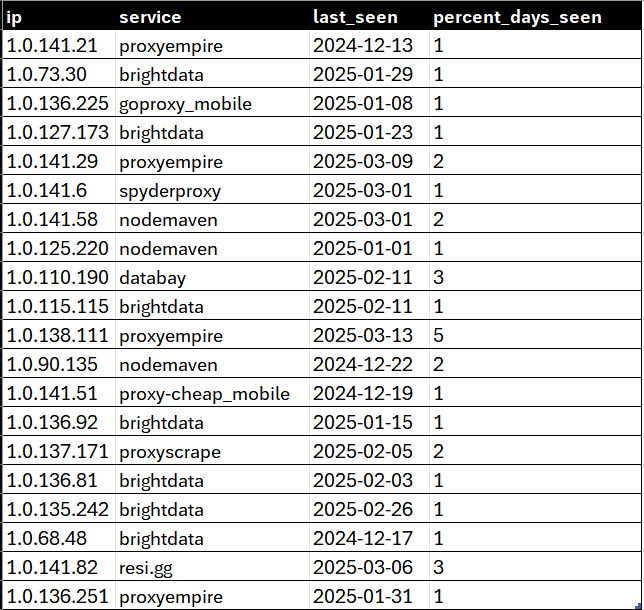
The IP to Residential Proxy dataset provides information on IP addresses associated with residential, mobile, or datacenter proxy networks, allowing developers to identify proxy IPs, understand their type, and use usage-based signals to build risk or filtering logic. The IP to Residential Proxy Database identifies residential proxy IP addresses from over 100 services, including residential connections, carrier/phone, and data center proxies, and tracks both IPv4 and IPv6 IPs, providing details on the associated proxy service, last seen date, and percentage of days active over a certain time window period—all in a single, comprehensive database. This detection can identify SIM farm-based, compromised device, and smartphone SDK-based proxy IP addresses and more.
Database Schema
The IP Residential Proxy database contains the following fields:
| Field Name | Example | Data Type | Description |
|---|---|---|---|
ip | 38.222.31.85 | TEXT | IPv4 or IPv6 address associated with a residential proxy. |
service | lightningproxies | TEXT | Name of the residential proxy service. Carrier/mobile services are suffixed with _mobile (e.g., soax_mobile) and datacenter IPs are suffixed with _datacenter (e.g. brightdata_datacenter) |
last_seen | 2024-09-07 | DATE | Last recorded date when the residential proxy IP was active, formatted as YYYY-MM-DD (ISO-8601). The timezone is UTC. |
percent_days_seen | 2 | INTEGER | Integer indicating the percentage of days the IP was active within a certain time window (30 days), reflecting its activity and frequency within a residential proxy pool. |
Types of Proxies Detected
We currently recognize three types of residential proxies:
- Standard residential proxies: Residential proxy IP addresses
- Mobile/Carrier/Phone-based residential proxy IP addresses
- Datacenter-based residential proxy IP addresses
Time Windows
The Residential Proxy data is scoped to a time window — a rolling observation period that determines how far back an IP address's proxy activity is considered. The oldest last_seen date in the dataset will always fall within this period relative to today. This is not a fixed update cycle; the window moves continuously.
- The Residential Proxy API uses a 7-day observation period.
- The Residential Proxy Database download uses a 30-day observation period.
The percent_days_seen field reflects the percentage of days an IP was active within the observation period. For example, a percent_days_seen value of 50 on a 30-day dataset means the IP was seen as a proxy on approximately 15 of the last 30 days.
Sample Database
- IP Residential Proxy Sample Database — CSV
- IP Residential Proxy Sample Database — JSON
- IP Residential Proxy Sample Database — MMDB
Filename Reference
curl -L https://ipinfo.io/data/resproxy_30d.csv.gz?token=$TOKEN -o resproxy_30d.csv.gz
curl -L https://ipinfo.io/data/resproxy_30d.mmdb?token=$TOKEN -o resproxy_30d.mmdb
curl -L https://ipinfo.io/data/resproxy_30d.json.gz?token=$TOKEN -o resproxy_30d.json.gz
curl -L https://ipinfo.io/data/resproxy_30d.parquet?token=$TOKEN -o resproxy_30d.parquet
Database File Metadata
Links
- IPinfo Residential Proxy — Snowflake Marketplace
- Available on Google Cloud Marketplace and GCP BigQuery:
- IPinfo Sample Database Repo — GitHub