


Get Unlimited Access to IPinfo Lite
Start using accurate IP data for cybersecurity, compliance, and personalization—no limits, no cost.
Sign up for freeColleagues and I have been having similar conversations with stunning regularity over the last few months. Because of the increasing complexity of internet infrastructure, interpreting the information we get has gotten more complicated, too.
For example, an IP address might be registered in one region and used in another. A single anycast address can represent infrastructure in multiple locations. Even the tools researchers use to measure the internet can produce misleading results.
These are some of the topics researchers explored at IMC 2026, where we returned as a platinum-level sponsor for the second year in a row.
We also co-organized the inaugural NewGeo workshop and contributed to several research papers presented at the conference.
Conferences like IMC are valuable because they bring together researchers developing new ways to measure the internet, validate existing assumptions, and make network data more reliable. This one was especially interesting.
Bringing the Geolocation Research Community Together
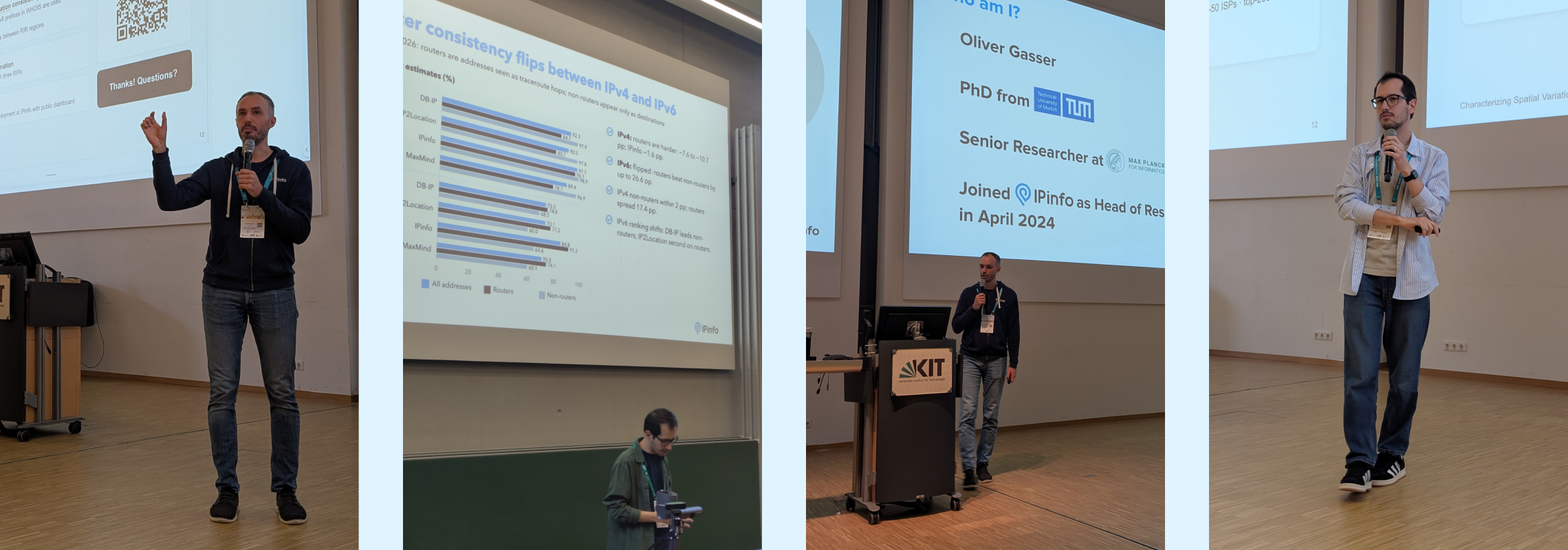
Our NewGeo workshop which we co-organized together with Rob Beverly from SDSU had about 25 researchers in attendance. We saw six presentations, including three IPinfo co-authored papers, which prompted discussions about the state of IP geolocation research.
IP geolocation is an active research area, with ongoing questions about accuracy, verification, and the techniques used to determine where internet infrastructure operates. Erik Rye’s presentation in particular, on reactive geolocation, introduced an approach that IPinfo's research team is interested in exploring.
IPinfo’s Presented Research
Our team authored or contributed to three different original research papers. Here’s a bit about each.
WHEREIS: IP Address Registration Geo-Consistency
I presented this work alongside Rob Beverly. Our work examines whether the physical locations of IP prefixes are consistent with their registration information. We used active measurements, including data from ProbeNet, IPinfo's internet measurement platform. Our findings? More than 98% of examined prefixes were geographically consistent, although inconsistencies varied across Regional Internet Registries and also appeared in commercial geolocation databases.
I’ll share more about this research specifically in the coming weeks. In the meantime, explore the WHEREIS dashboard here.
Characterizing Spatial Variation in Internet Access Latency: A Multilevel Approach
Research team member Jonatas presented his research conducted in collaboration with the University of Chicago, examining latency and jitter using crowdsourced Ookla Speedtest data. He found that internet performance varies much more within neighborhoods than between them. Differences in infrastructure across counties and states appeared to explain more variation than neighborhood-level demographic characteristics.
Endless Cookies: Exploring TCP Fast Open on the Internet
Research team member Fahad co-authored research examining the deployment of TCP Fast Open, a technology designed to reduce connection establishment latency. Researchers found TFO enabled on 24% of tested addresses on port 443, suggesting greater adoption than previously assumed. Adoption was particularly high among major providers, including Cloudflare (99%), Akamai (59%), and Google (40%).
IPinfo's contributed research was part of broader work exploring how to improve the accuracy and reliability of internet measurements.
Approaches to Understanding Internet Infrastructure
Here were a few of the most interesting presentations from other researchers, and what they could mean for future measurement techniques.
Measuring Starlink Aviation Around the World
Conventional IP geolocation becomes particularly challenging when internet connectivity is mobile and satellite-based. Jinwei Zhao presented research exploring how to infer the location of Starlink-connected aircraft using network information associated with Starlink points of presence and MPLS.
Rooting Out Incorrect RIPE Atlas Probe Geolocations
Katherine Izhikevich presented research identifying incorrectly located RIPE Atlas probes. At IPinfo, we already validate probe locations using latency measurements. The presented research uses a different methodology involving DNS root servers. We, of course, believe strongly that measurement infrastructure must itself be validated and will explore this research further.
TTL Jumps: Unexpected TTL Rewrites Impacting Inferences from Traceroutes
Sebastian Kappes presented research on TTL rewriting, which can affect how traceroute results are interpreted. IPinfo already filters many of these cases and is investigating further improvements.
What the Research Community Wants from IP Data
Conversations at IMC revealed further opportunities to make internet data more useful and informative.
Anycast Infrastructure
Three researchers independently expressed interest in a dataset showing all identified anycast replica locations. (Because anycast allows the same IP address to be served from multiple locations, making a single geolocation result insufficient for some applications.)
We already identify multiple anycast locations through our measurements, but this information is not currently distributed as a standalone dataset. That’s raised some interesting questions about how to make that information more accessible.
Opportunities for Collaboration
We spoke with RIPE NCC about exploring ways to visualize geolocation data and work with historical IP information. We also talked to UNICEF Giga about potential future research collaborations and applications of IP data.
Why Continued Internet Measurement Matters
The conference’s takeaways reinforced our research philosophy and ongoing investment in internet measurement.
Our understanding of the internet improves when assumptions are tested against observations. IMC 2026 demonstrated how much there is still to learn, and why ongoing measurement and collaboration are essential to building more accurate, reliable IP intelligence.
Share this article


About the author
As head of research at IPinfo, Oliver leads IPinfo’s research team, collaborates with academic institutions, and conducts cutting edge research.