


Get Unlimited Access to IPinfo Lite
Start using accurate IP data for cybersecurity, compliance, and personalization—no limits, no cost.
Sign up for freeMost people picture a VPN the same way. You install an app, pick a country, and your traffic leaves through a server that a company runs in a data center somewhere. But a growing group of apps works differently. The exit is run by another person, on a rented server or sometimes on their own home connection, and that person gets paid for it.
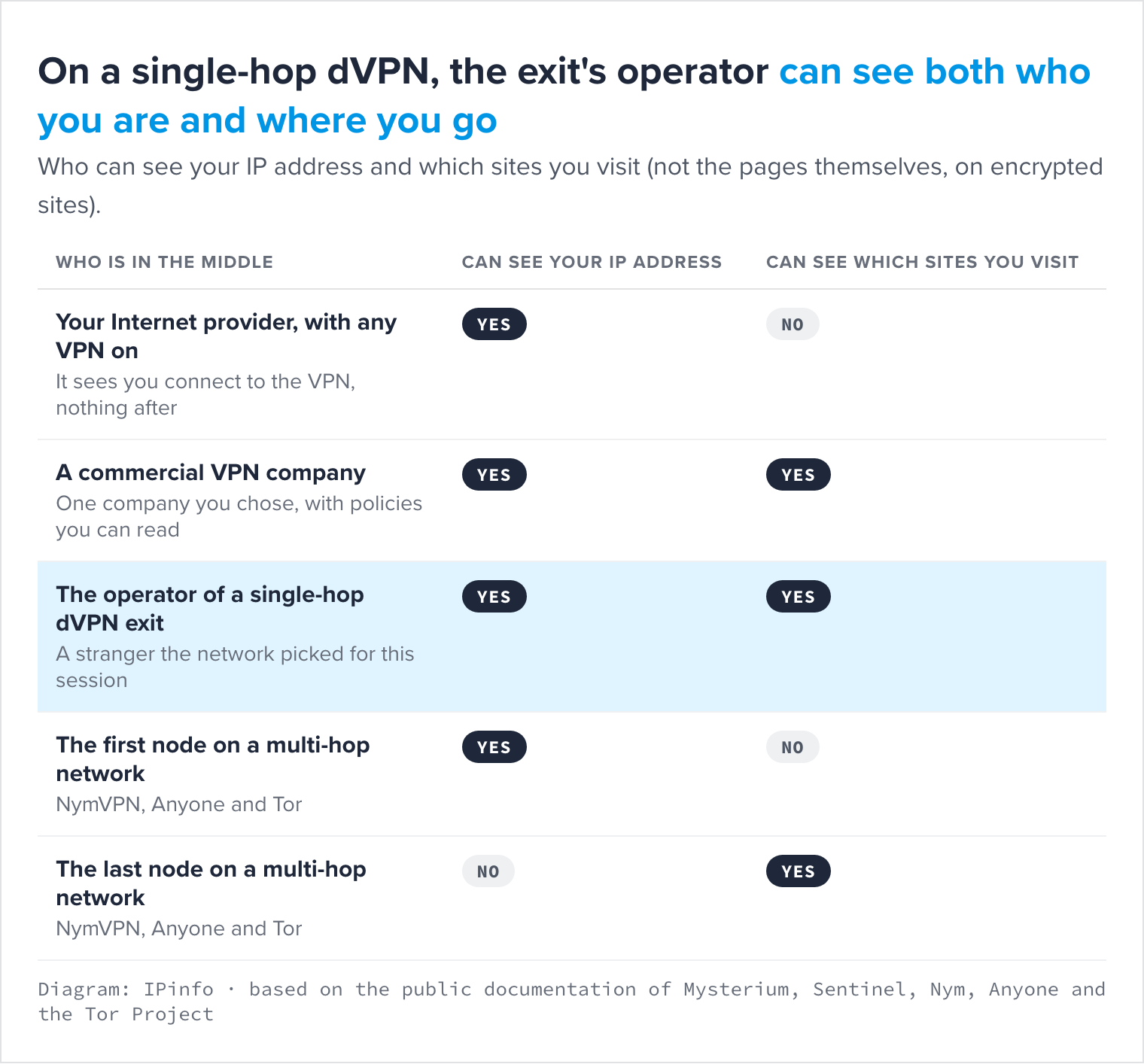
These are decentralized VPNs, or dVPNs. Twelve dVPN apps on Google Play have been installed about 3.5 million times, compared to about 121.5 million for NordVPN, a traditional VPN provider. To anyone who uses IP data, they matter more than their size suggests. Their exits are spread across thousands of small operators. Some are working hard not to look like VPNs, and many of their users are trying to get past a block.
For organizations relying on IP intelligence for fraud prevention, compliance, or content licensing, that creates new challenges for detection and classification.
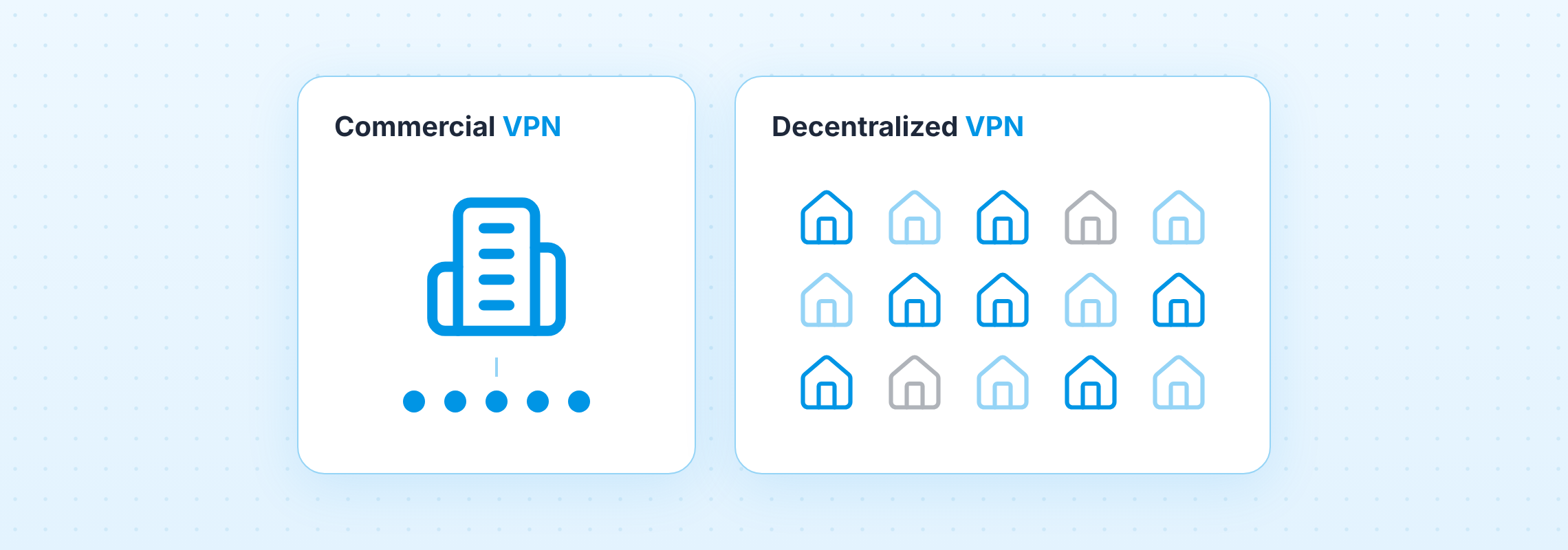
Commercial VPNs vs. Decentralized VPNs
A commercial VPN works like a hotel chain. One company owns every room, sets the rules, and answers for what happens there. A decentralized VPN works more like a home-sharing app. Thousands of hosts list a room, the app matches you with one, and it handles payment, usually in its own cryptocurrency token.
Some hosts are families with a spare room: a home connection, or a router box like the one Deeper sells for this. Many are closer to professionals renting out flats, running the software on cheap rented servers. Nym says openly that most of its exits run in data centers.

The idea is also older than crypto: Tor has run on volunteer relays since the early 2000s, and VPN Gate, an academic project at Japan's University of Tsukuba, has run on volunteer servers since 2013. Today, people in Iran and Russia also pass around access keys for tools like Outline in Telegram channels. What the newer networks add is money, a reason for many more people to become hosts.
Networks you'll come across include Mysterium, Nym, Sentinel, Orchid, URnetwork, Anyone, Deeper, and Beldex. A network and an app are not the same thing. Sentinel shows up on Google Play under many names, from Independent dVPN to DVPN by NORSE.
The Role of Blockchain in Decentralized VPNs
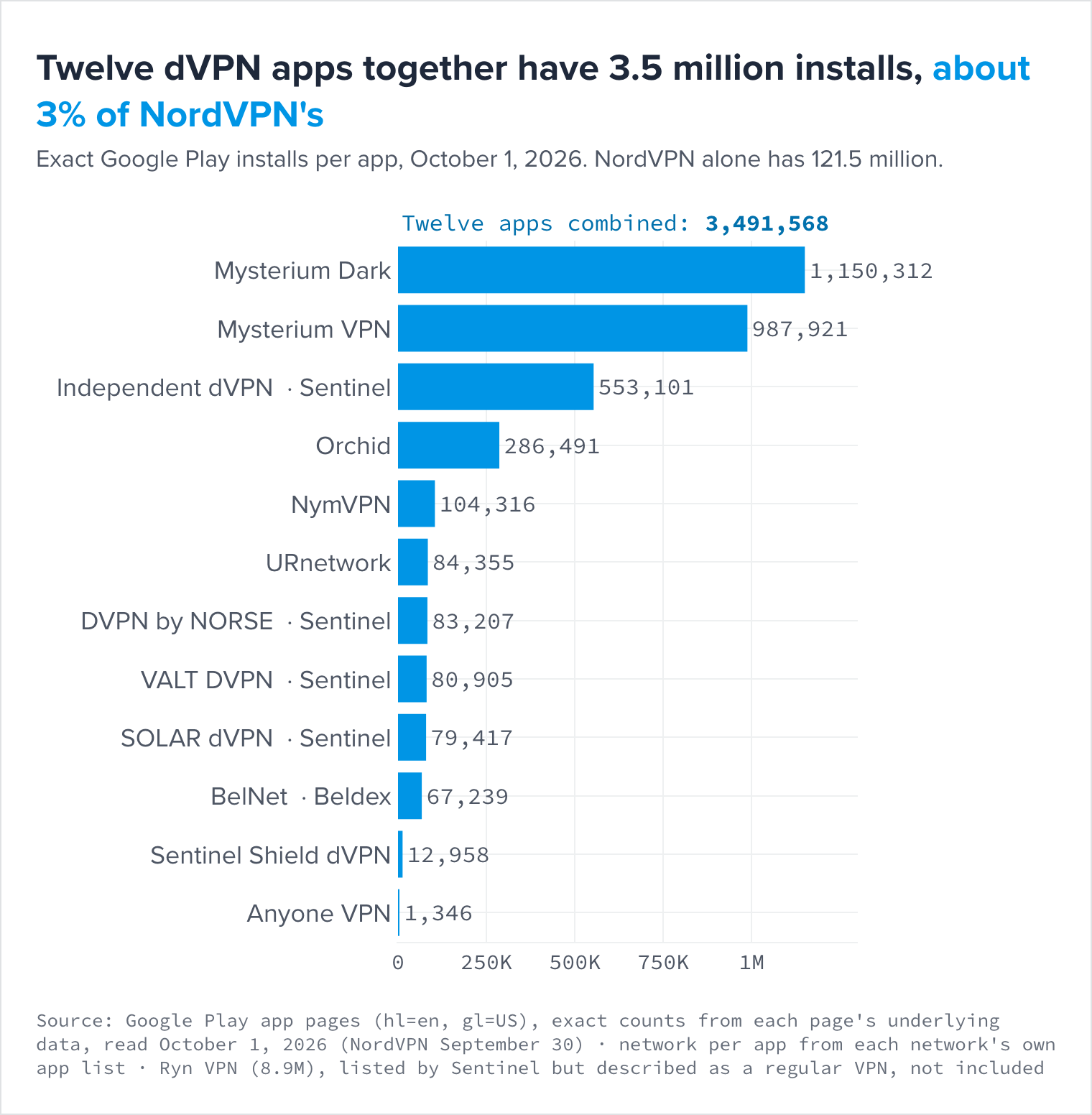
In a home-sharing app, one company lists the hosts, handles payments, and enforces the rules. Decentralized VPNs use blockchains to handle some of those jobs, although the apps themselves, and often the matching of users to hosts, are still run by individual companies.
The blockchain typically serves three purposes. It maintains a public register of nodes, processes payments, and creates financial incentives for operators to participate. Different networks handle these differently. Mysterium settles batches of small payments in a single transaction, while Orchid uses a lottery-based payment system. On Nym, operators stake tokens to participate, with larger stakes increasing their chances of being selected.
What blockchain doesn't do is lock the door. The tunnel is ordinary VPN encryption. Public payment records can even create privacy risks if transactions can be linked to individual users. That's why Nym sells access through anonymous credentials, which prove you paid without showing which payment was yours.
Who Can See Your Traffic?
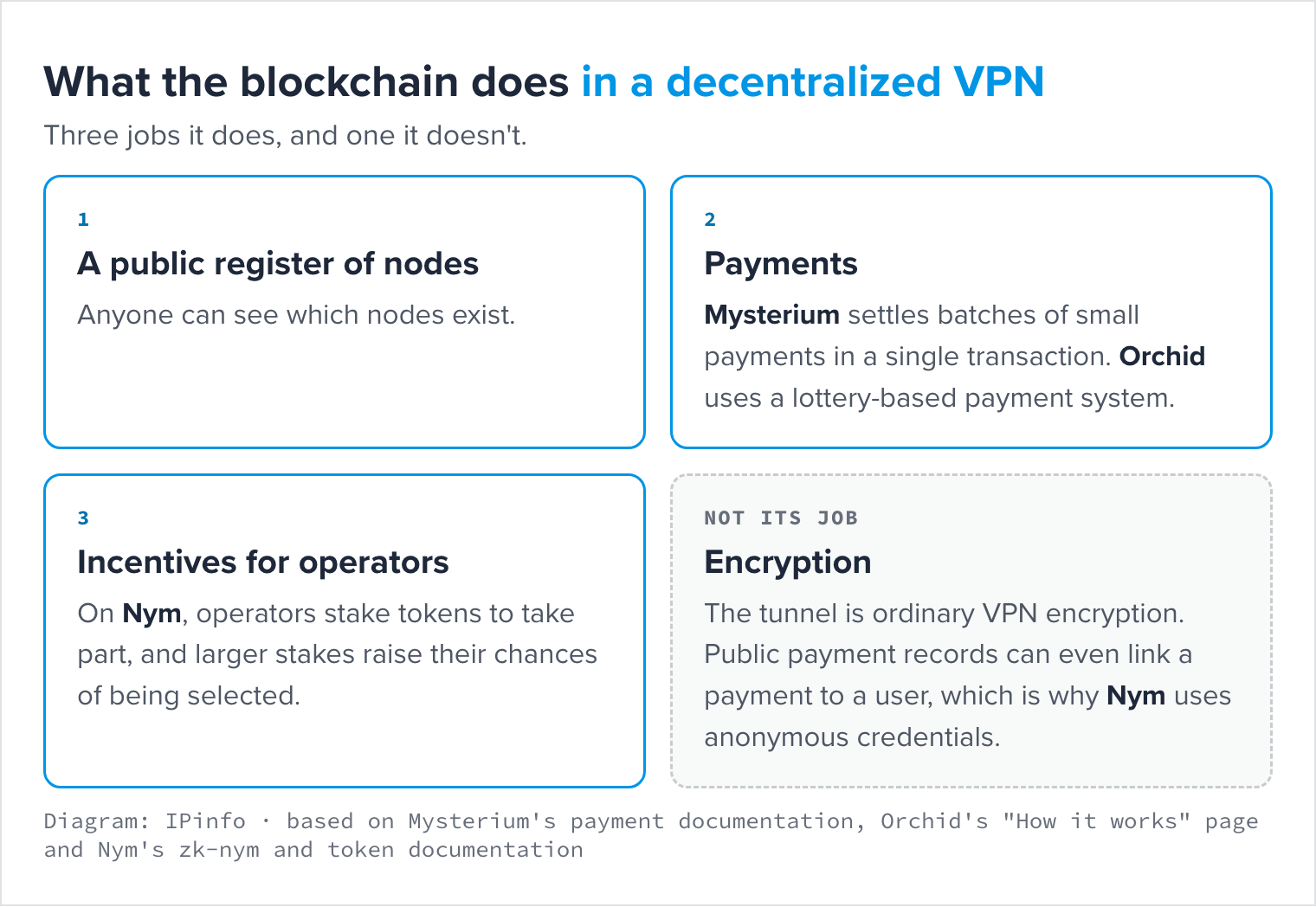
Spreading VPN exits across independent operators doesn't necessarily make your traffic more private. With a commercial VPN, you move your trust from your Internet provider to one company, whose policies you can read.
On a single-hop decentralized VPN, the exit's operator can see your IP address and the sites you visit, just like that company can. The difference is that the operator is a stranger the network picked for you.
Some networks work differently. Anyone is built on Tor's design and sends traffic through three relays. NymVPN's fast mode uses two servers, an entry and an exit, and its mixnet mode five, with added fake traffic to hide patterns. Like Tor, that splits what each node knows, so no single one sees both who you are and where you're going.
A Small But Growing Market
As of October 1, 2026, the twelve dVPN apps we follow added up to 3,491,568 installs, led by Mysterium's two apps at 1,150,312 and 987,921.
The total leaves out Ryn VPN, which Sentinel's site lists as one of its apps. (Its store page, with nearly 8.9 million installs, describes an ordinary VPN and never mentions decentralization.) NordVPN alone has 121.5 million, and Tor Browser 53.1 million. The dVPN total is a floor because installs count devices, not users, and there may be apps we don't follow.
However, since May 2025, the smaller apps are gaining ground. Six of them moved up at least one install tier, NymVPN from 10K+ to 100K+ among them, while the established ones held steady. Nym's public list of exits grew too, from a median of 560 a day in May 2026 to 709 in September.
Where Decentralized VPNs Are Popular
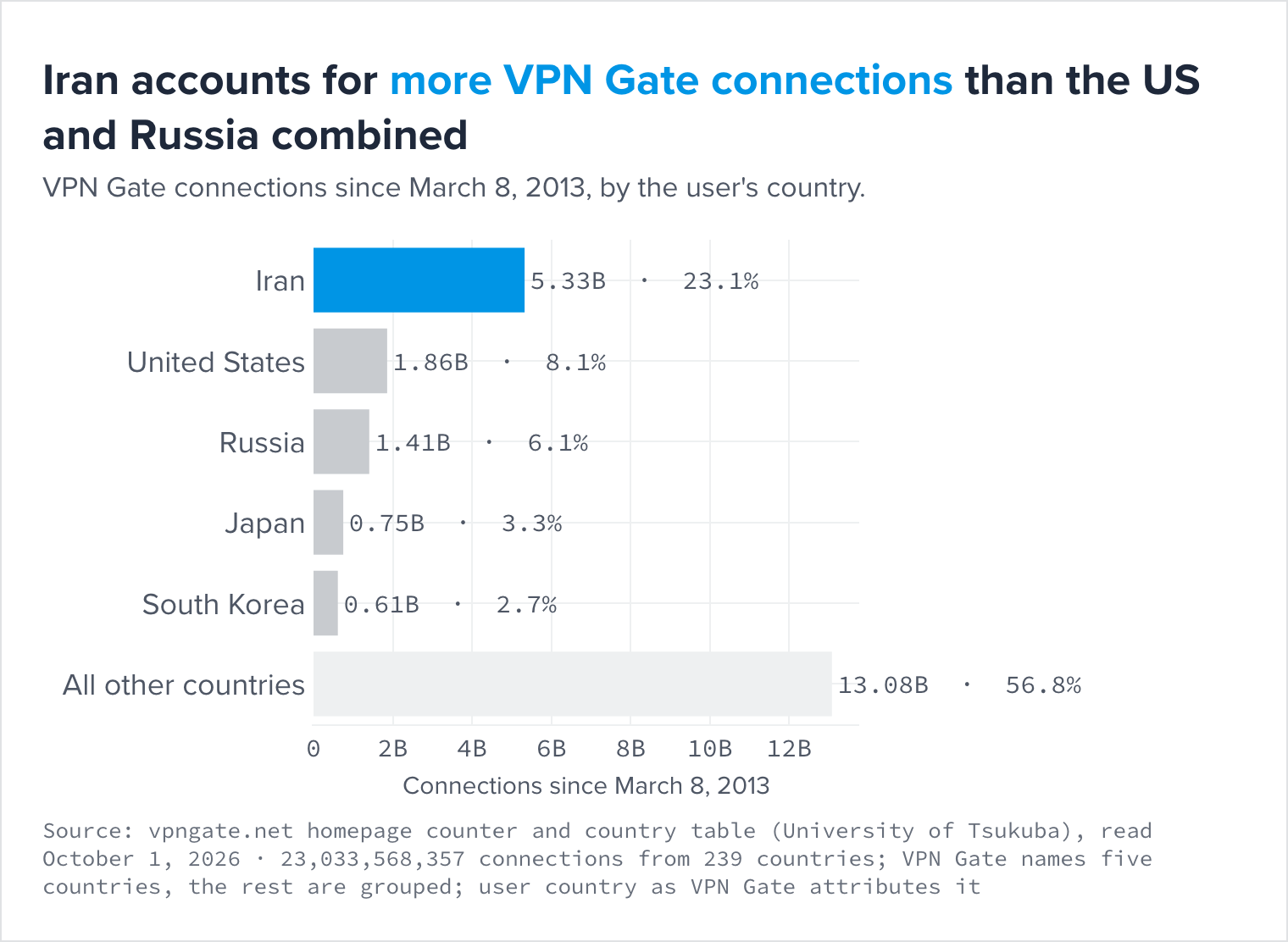
Getting around censorship is one reason people use decentralized networks, and VPN Gate's numbers show how significant that demand can be. Of its 23 billion connections since 2013, 5.3 billion came from users in Iran. That's 23% of the total, more than the United States and Russia combined.
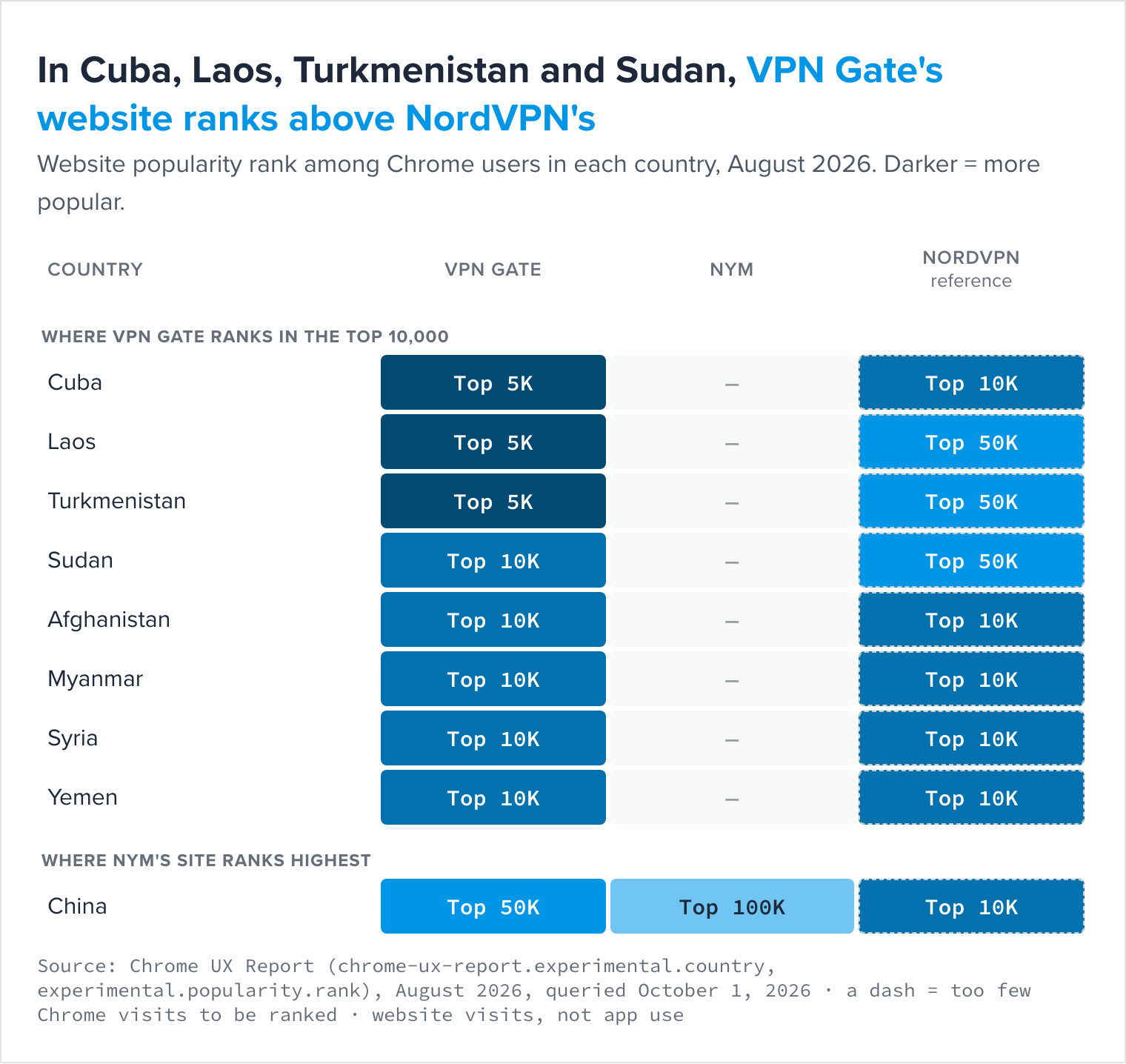
Website popularity shows a similar trend. Chrome's public data ranks websites country by country. VPN Gate's site is among the top 5,000 in Cuba, Laos, and Turkmenistan, and among the top 10,000 in Sudan, Afghanistan, Myanmar, Syria, and Yemen.
In Cuba, Laos, Turkmenistan, and Sudan it ranks above NordVPN's.
Other networks show different geographic patterns. Nym's and URnetwork's websites rank highest in China, followed by Iran and Russia. Mysterium's performs best in Ghana, Nigeria, and Côte d'Ivoire.
Several of these countries restrict Internet access. Freedom House rates Internet freedom in Cuba, Myanmar, and Sudan as "Not Free," with China and Myanmar receiving the lowest scores among the 72 countries it assesses.
These patterns suggest interest in decentralized VPNs where Internet access is restricted, but website visits aren't the same as VPN connections. Some visitors may be looking to earn money as hosts rather than use the service, and the data can't distinguish between them.
The Risks of Running an Exit Node
For hosts, the appeal is money. Mysterium's app invites its users to make money from bandwidth they aren't using. But when someone operates a VPN exit node, other people's traffic leaves through their IP address. If that traffic triggers an abuse complaint or gets the address blocked, the consequences fall on the host.
Nym is unusually frank about this in its operator docs, with a blunt warning for anyone running a node at home: "The legal exposure to risk-reward ratio is net negative."
That matters for IP reputation: an address can get flagged for activity its owner had nothing to do with.
When VPN Traffic Looks Residential
Many websites block or limit traffic from hosting networks, because that's where most commercial VPN exits live. In IPinfo's December 2025 analysis, 83.6% of provider-attributed commercial VPN addresses sat on hosting networks.
Some decentralized VPN operators are looking for ways around this. Nym's documentation says its users get blocked for exactly that reason. NymVPN uses IPinfo's network type in its own API, and the docs explore getting address space registered to consumer ISPs so exits look residential.
In hotel terms, some hosts are listing rented flats as family homes.
That creates a challenge for anyone relying on IP data. An address belonging to a residential network isn't necessarily being used by a residential customer, and an IP's network type alone won't tell you whether it's a VPN exit. Identifying that activity requires more than checking who owns the address.
At IPinfo, we track VPNs because our customers use that data for fraud checks, content licensing, and compliance. We currently identify 380 VPN providers and now detect decentralized VPN exits too. We built that detection as part of an ongoing, larger research effort with academic partners.
As decentralized VPN networks grow and their exits change, keeping VPN detection accurate means continuing to observe how IP addresses are actually being used.
We're exploring specific data perspectives on decentralized VPNs, and we'll share them in future posts.
Sources: Google Play app pages and IPinfo's weekly Google Play scrape (May 2025 to October 1, 2026); Nym's public node directory and operator docs; VPN Gate's public statistics (October 1, 2026); Chrome UX Report (August 2026); Freedom House, "Freedom on the Net 2025"; each network's own documentation; IPinfo VPN data (December 2025 and September 2026).
Share this article


About the author

João Tomé is an Internet Data Research Editor at IPinfo, finding trends and stories about how the Internet works and changes. He has a background in journalism, data storytelling, and podcasting, including five years at Cloudflare. joaotome.com