


The Internet Brief #2 | Grounded US flights, unpatched fridges, and midnight GTA VI speed tests

Get Unlimited Access to IPinfo Lite
Start using accurate IP data for cybersecurity, compliance, and personalization—no limits, no cost.
Sign up for freeThe Internet Brief comes out once a month. Get it by email or on LinkedIn.
Hi, I'm João, and some of you know me from my years as a journalist or at Cloudflare. This is where I now share, once a month (for now; some months it may come more often), what I find in IPinfo's data about how the Internet works and breaks. Last month I promised to come back to PHP and check how fast servers update. That's below.
In this issue: the FAA ground stop seen from in-flight Wi-Fi, France's fridge controllers going offline as six new flaws appeared, why Western Europe ran speed tests at midnight, who patched PHP after its emergency fix and who didn't, a viral Linux bug measured, Internet addresses registered in Africa but used elsewhere, Starlink passing a million addresses, and the outages since the last issue.
But first, this issue starts with a short guide to telling outages from cyberattacks, using the past two weeks as examples.
How to tell if an outage is a cyberattack
In the first half of November, Microsoft's business email went down for a day, US flights were grounded, Chase's online banking failed, and an attacker put malicious code on the websites of 178 organizations at once. Only one of those is known to be an attack. Most big outages that look like attacks are self-inflicted: a bad update, a configuration change, a cable cut, a power failure, or a government order. The timeline in the outages section below shows the past two weeks, colored by cause.
Seven questions to ask:
- Are the routes still there? If a company's routes or DNS vanished, it's almost always its own change. A DDoS attack usually leaves routes up while the service slows down.
- How wide is it? One provider failing in many countries points to a bad update. One region points to cables, power, or fire. Every network in one country at exam time points to a government shutdown.
- When did it start? Overnight local time or a deploy window points to maintenance.
- How did it recover? A rollback takes minutes or hours. Ransomware takes days or sometimes even weeks.
- Which layer broke? If the network answers but one app is down, look at the app or a supplier, not the Internet. Outages are often partial: a bank's website can load while logins fail.
- What does the company say? Days of "investigating" is the warning sign. Confirmation often comes later, through required disclosures, such as an SEC Form 8-K within four business days in the US.
- Does a second source agree? Downdetector counts user reports, so a rumor can drive it as much as a real outage. A spike is a reason to check, not proof.
Is this month unusual? It feels like it, but clusters like this aren't new. CISA's catalog of vulnerabilities known to be exploited added 15 entries from November 1 to 16, about what this year's pace would predict. A year ago, AWS, Microsoft Azure, and Cloudflare all had major outages within a month of each other, between October 20 and November 18, 2025.
Attackers go for suppliers. On November 16, a flaw in Optimizely, a tool websites use to test different versions of their pages, let an attacker put malicious code on the websites of 178+ organizations in one day, according to Report URI. Most of those sites were running third-party code they never reviewed. One compromise reaches thousands of victims.
AI speeds up attacks; patching is still slow. On November 16, Google's threat intelligence team reported an AI framework that turns security patches into working attacks with no human involved, and Google Project Zero and Anthropic shortened their bug disclosure deadlines because of AI. Patching hasn't sped up the same way: see the PHP2Shell numbers below.
The Internet is fragile and strong at the same time. It wasn't designed for what it became, which is why it breaks in surprising ways. But companies that compete every day share data, warn each other, and help each other recover, often within hours. When Optimizely was attacked, the researchers who found it published the details the same day.
In-flight Wi-Fi on US airlines fell to 15% of normal during the FAA ground stop
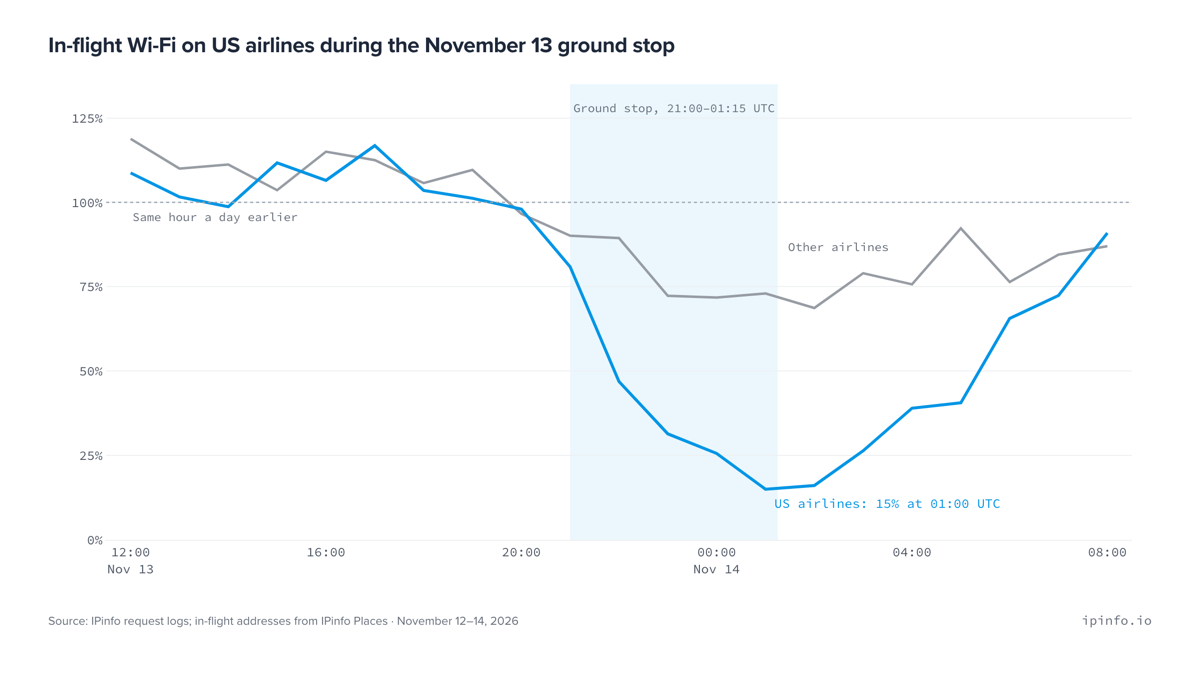
On November 13, the FAA stopped departures across the US from about 21:00 UTC (4 p.m. Eastern) until 01:15 UTC, after communication and radar problems at its air traffic control centers. Transportation Secretary Sean Duffy said a router flooded the FAA's network during routine telecom maintenance. On November 14, the FAA said the root cause wasn't yet confirmed, and officials said they saw no sign of an attack.
IPinfo's data shows it from the air. The number of in-flight Wi-Fi addresses on US airlines making requests fell to 31% of the day before at 23:00 UTC and to 15% at 01:00 UTC, as planes landed and new ones didn't take off. Other airlines dipped to about 70%. US airlines were back to about 90% of the night before by 08:00 UTC.
Nine in 10 of France's exposed fridge controllers went offline. Now there are six new flaws
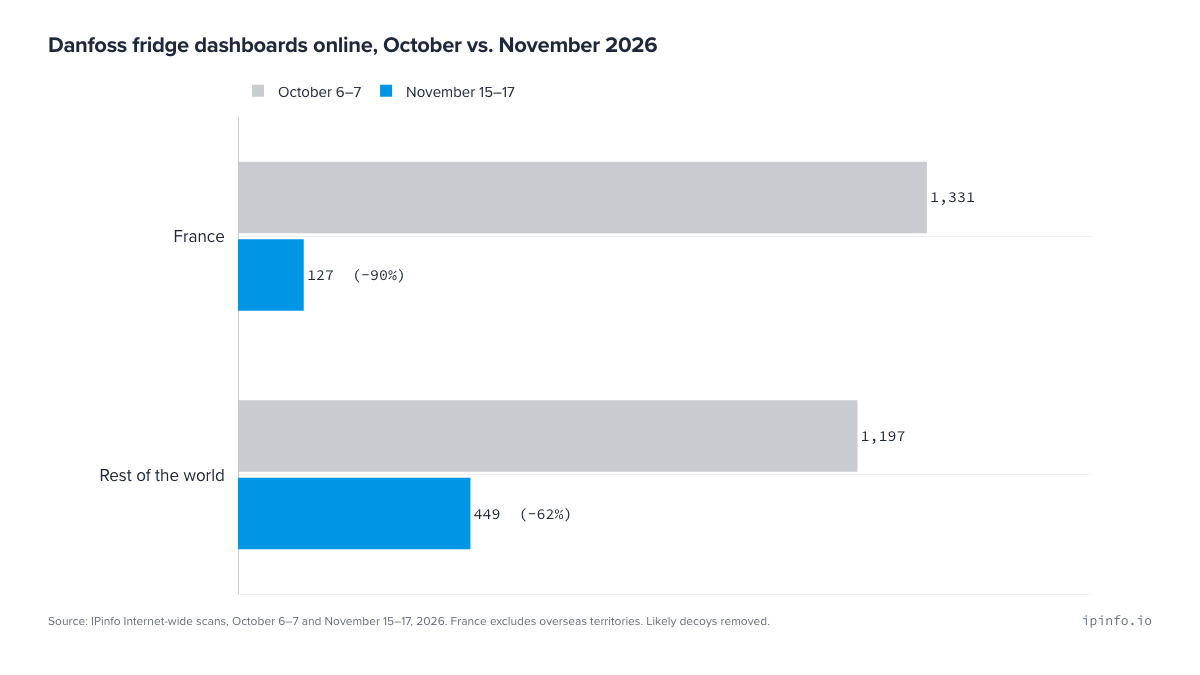
After the October attacks on supermarket fridges in France, most of the country's exposed controllers went offline. In IPinfo's scan of October 6–7, 1,331 Danfoss dashboards were online in France. By November 15–17, 127 were left, a drop of about 90%, against 77% worldwide (from 2,528 to 576). That matters now: researchers at Midnight Blue found six flaws in Danfoss AK-SM 800A refrigeration controllers, the kind supermarkets use, that let an attacker take one over without logging in, The Hacker News reported on November 16. There's no patch yet, and agencies in Belgium, Ireland and Germany told operators to take the controllers off the Internet. On November 15–17, 342 dashboards were still online in Europe, including 18 in Germany and 9 in Belgium.
Why do Western Europeans run speed tests at midnight?
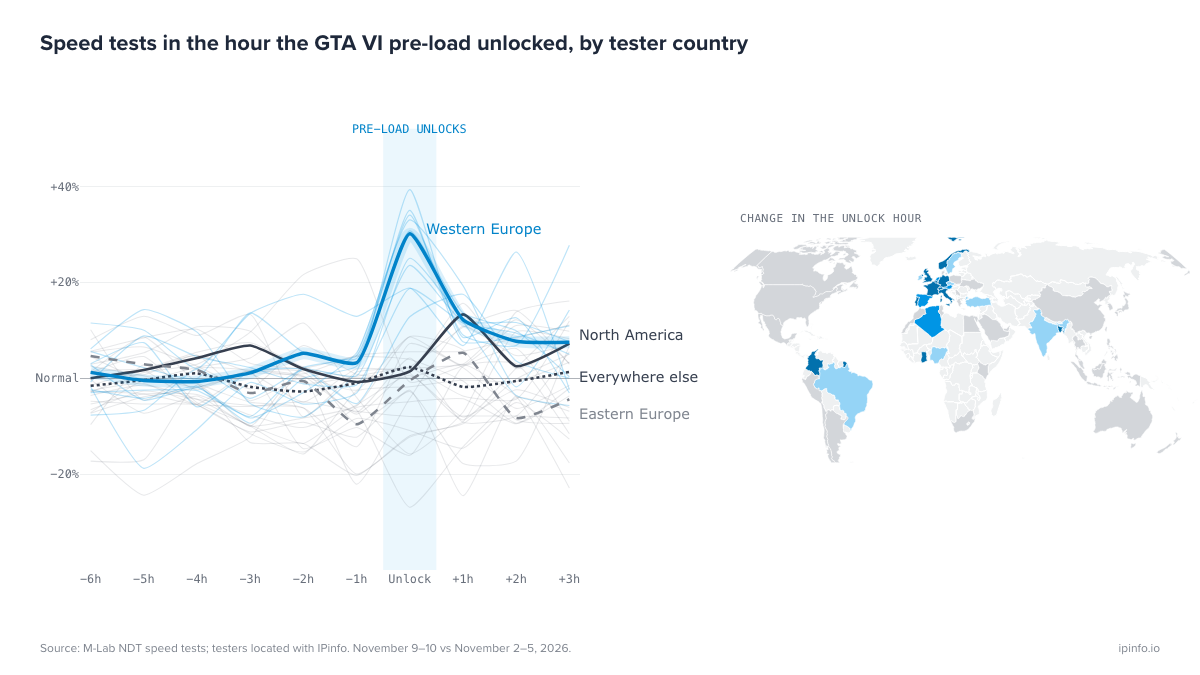
When the GTA VI pre-load opened at local midnight on November 9–10, the number of networks running speed tests in Western Europe jumped 30% in that hour, while North America didn't change. I asked on LinkedIn whether that was a habit or this one game. It's game launches: the same measure rose 17% when Call of Duty unlocked at midnight in October, but barely moved when the iPhone update came out in September.
PHP2Shell: hosting companies patched for their customers, most others didn't
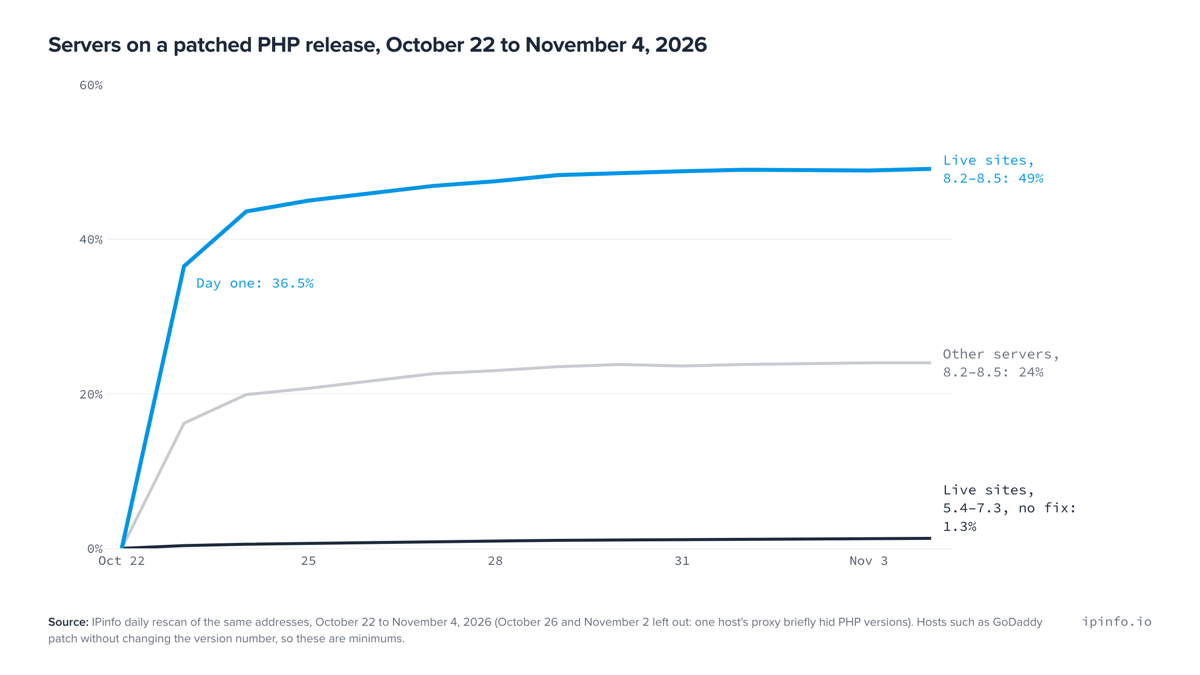
On October 21, the PHP team released emergency fixes for two critical flaws, now known as PHP2Shell. Official updates exist only for versions 8.2 to 8.5. For two weeks after the fix, IPinfo checked the same group of about 1.3 million web server addresses every day.
By November 4, 49% of the live sites on 8.2 to 8.5 showed a fixed version (43,172 of 87,865), most of them from the first day. On the older versions 5.4 to 7.3, which get no official update, only 1.3% of live sites moved to a fixed release. All of these numbers are a floor: some hosting companies patch PHP without changing the version it reports.
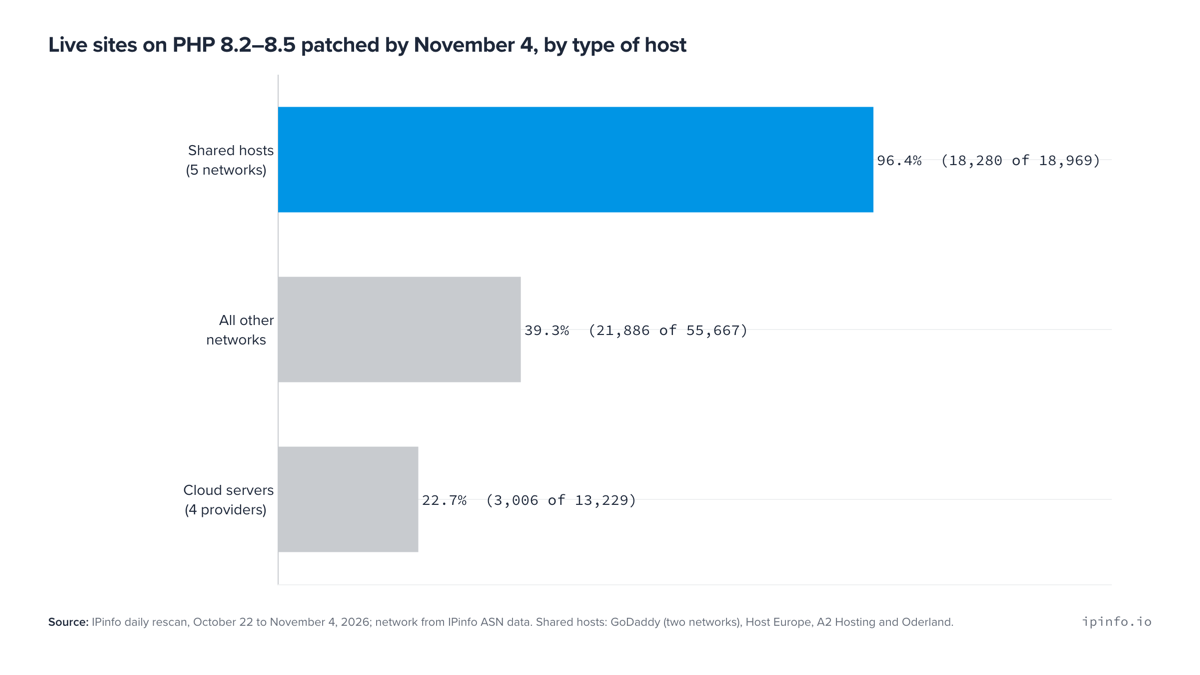
Who patched depended on who runs the server. Shared hosting companies such as GoDaddy and Host Europe showed a fixed version on 96% of their customers' live sites on 8.2 to 8.5. On cloud servers at Amazon, DigitalOcean, Oracle and Contabo, where owners update their own, it was 23%. Counting each network once, the typical network patched 32% of its live sites. On the versions with no official fix, the typical network patched none.
A viral Linux bug, and the rare feature its demonstrated attack uses
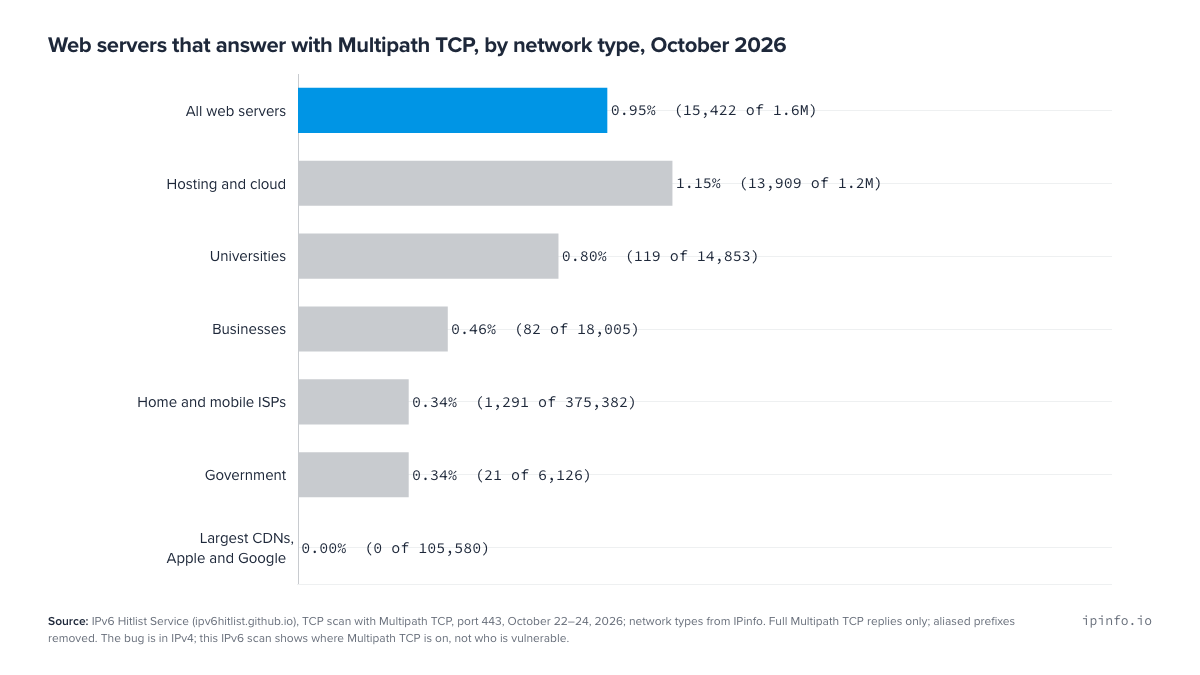
A Linux flaw that went viral on November 1 (CVE-2026-98432) is real: an unpatched server can, in principle, be taken over remotely, and the fix is a kernel update and a reboot. The demonstrated attack used Multipath TCP, but in a scan of 1.6 million web servers over IPv6 by the IPv6 Hitlist Service on October 22–24, only about 1 in 100 answered with that feature, though 44% of servers running Caddy did. So the demonstrated attack reaches only a small share of servers, but every server still needs the fix, because the bug itself isn't limited to Multipath TCP.
Four in five addresses registered in Africa but used abroad sit with one company
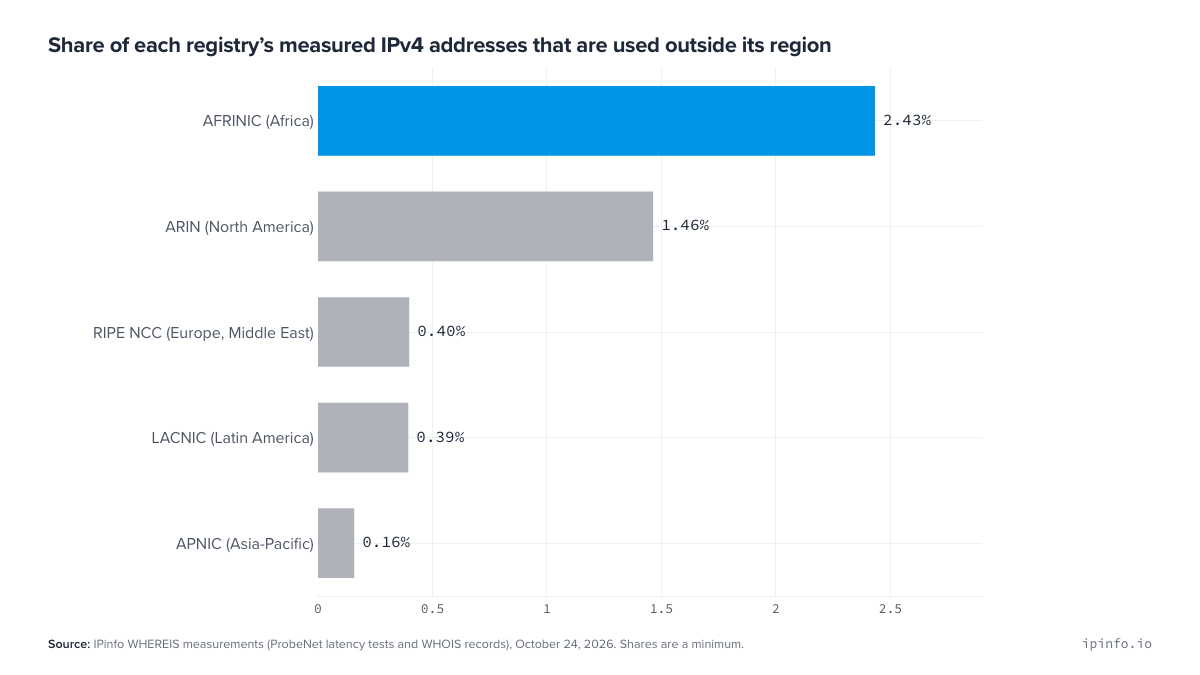
Every Internet address is registered with one of five regional registries, and AFRINIC is the one for Africa. IPinfo checks where addresses actually answer from, using the speed of light: a reply that comes back within a few milliseconds can't have crossed an ocean and returned.
On October 24, 2.43% of the AFRINIC addresses IPinfo could measure answered from outside Africa, more than for any other registry. 81% of them sat inside four address blocks registered to one company, Cloud Innovation Ltd, which has been in court with AFRINIC since 2021. Without those four blocks, AFRINIC's share would be 0.5%, lower than that of ARIN, the registry for North America.
Starlink passes a million IPv4 addresses
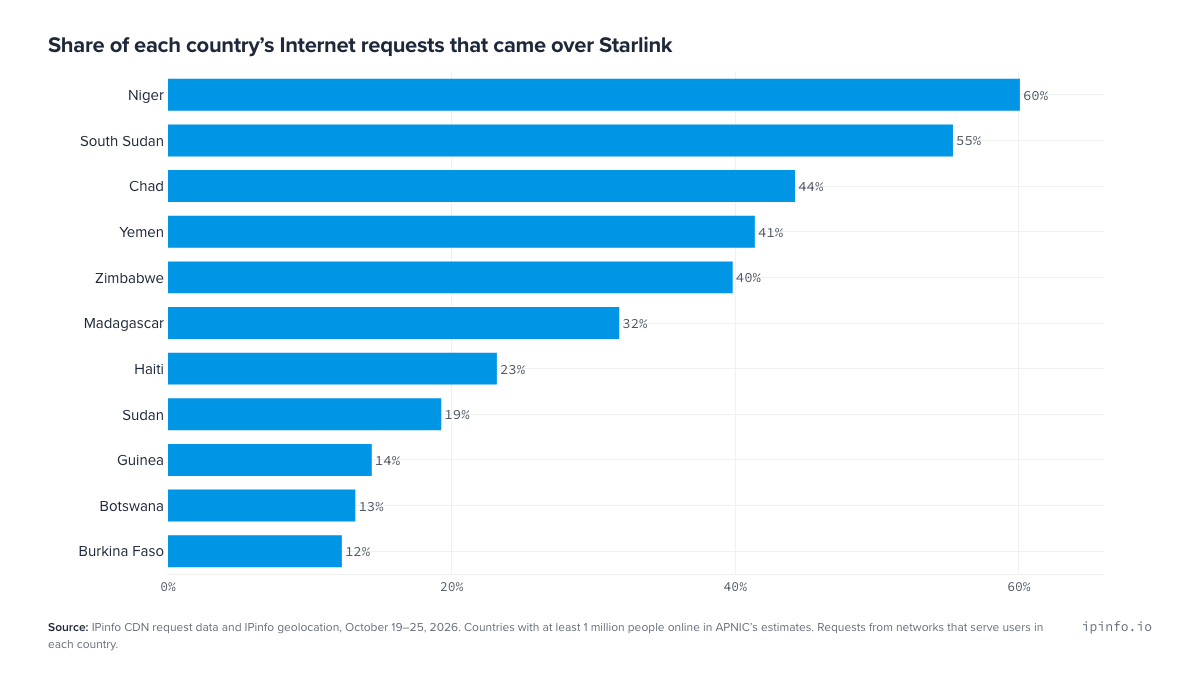
SpaceX's four Starlink networks held 1,036,544 IPv4 addresses on October 31, up 95% from a year earlier, after passing one million on October 8. Starlink now lists addresses for 223 countries and territories.
In most of them, it's a small part of how people get online. In the US, 0.6% of the Internet requests in IPinfo's CDN request data came over Starlink in the week of October 19–25. In Niger (60%) and South Sudan (55%), it was more than half, and in Chad, Yemen, and Zimbabwe it was 40–44%.
Starlink is also a big part of Wi-Fi on flights, including on some of the US airlines grounded on November 13. In IPinfo's October sample of 1,988 devices on airline Wi-Fi, about 4 in 10 were on Starlink, and at least 18 airlines had passengers on Starlink Wi-Fi.
Outages since the last issue
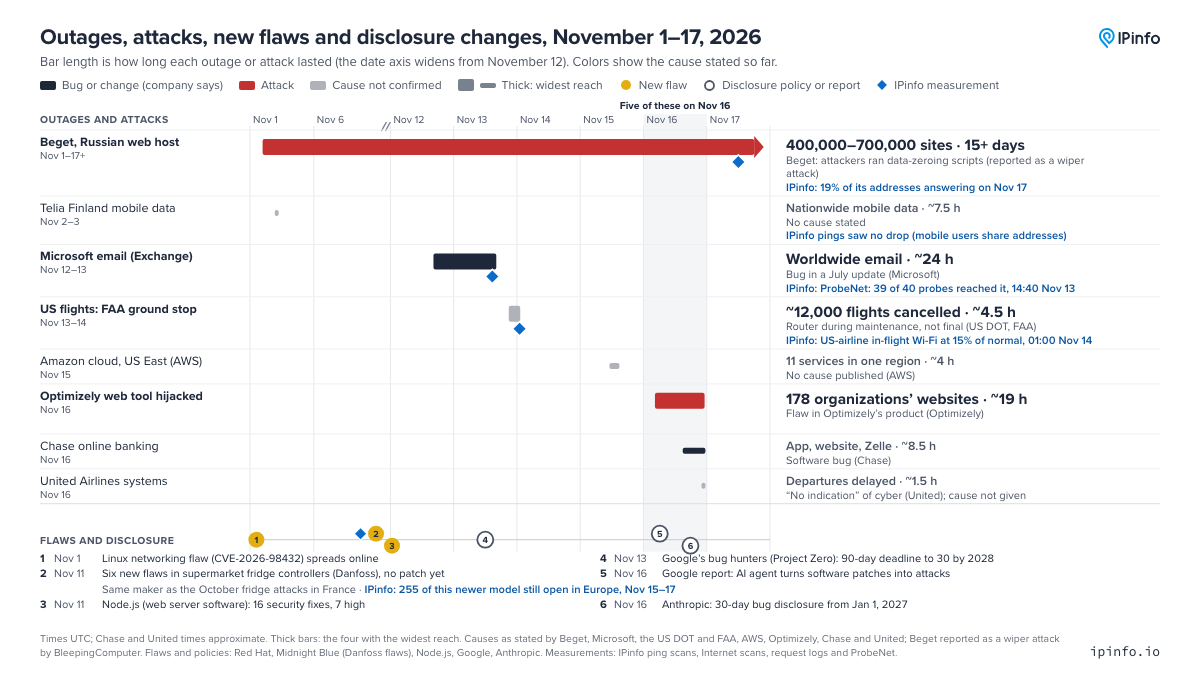
The one big attack in this period didn't hit a network at all. On November 16, a flaw in Optimizely, a tool websites use to test different versions of their pages, let attackers put malicious code on the websites of 178 organizations, according to Report URI and Optimizely.
Since the last issue, IPinfo's ping checks caught these outages. Most lasted a few hours. One web host was still mostly down after two weeks.
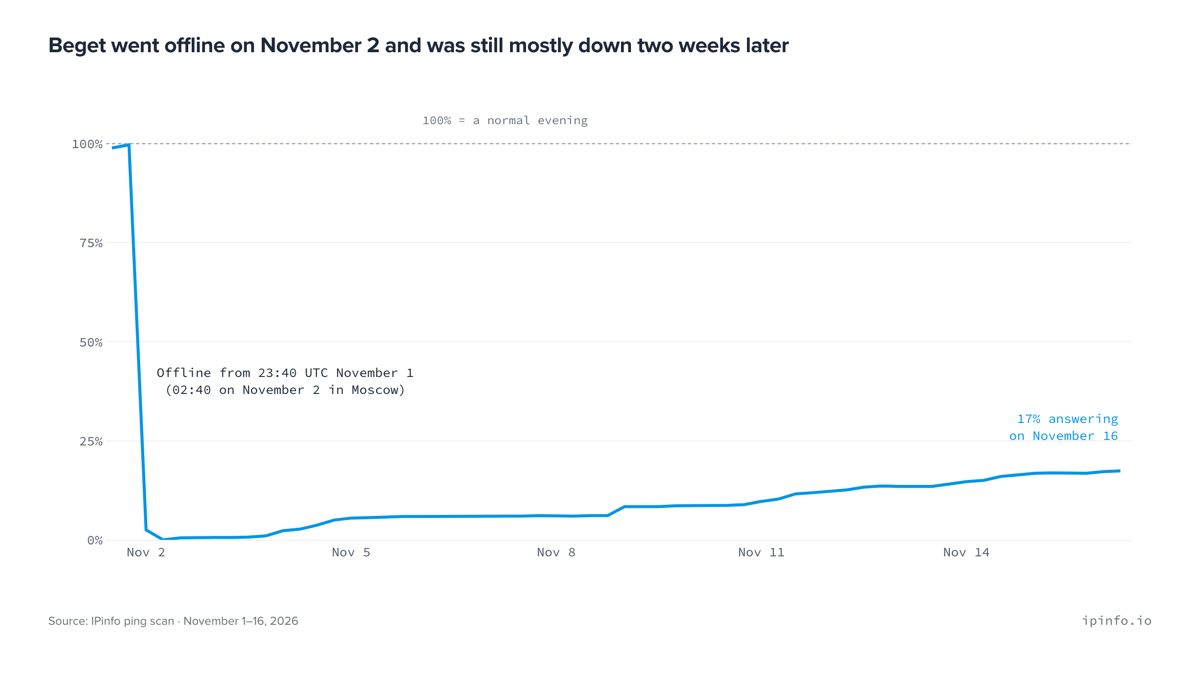
- Russia: Beget, a web host with over 700,000 domains, went offline late on November 1 UTC. Two weeks later, on November 16, only about 1 in 6 of its addresses answered. Beget says a massive attack on its infrastructure caused it.
- Russia: on November 12, about 4 in 5 addresses in the Krasnodar region and half of those in Stavropol stopped answering for about two and a half hours. No cause has been reported.
- Saudi Arabia: on November 8, fewer than 1 in 10 addresses on Mobily's network answered for almost an hour, and it took about three hours to recover fully.
- Spain: a storm blackout left La Palma without power for almost four hours on November 2. Fewer than 1 in 10 of the island's addresses answered, while Tenerife, on a separate power grid, was unaffected.
- Microsoft: Exchange Online, Microsoft's business email service, was down for many users from about 16:00 UTC on November 12 until 16:10 UTC the next day. Microsoft blamed a defect in a July update to its network gateway servers and said there was no sign of an attack. At 14:40 UTC on November 13, 39 of 40 IPinfo ProbeNet probes around the world could connect to its servers again, about 90 minutes before Microsoft declared the service healthy, though email may not have loaded yet.
Keep exploring IPinfo data
Follow IPinfo for more research, data findings and observations about how the Internet works, on the IPinfo Blog and in our Research & Reports.
Get The Internet Brief by email: subscribe here.
Got a question, a data request or an idea to make this better? Write to me at joao@ipinfo.io.
For journalists: if you want the data behind any of these charts, a different cut for your story, or to talk with the team, write to press@ipinfo.io.
Data: IPinfo's scans, ping checks, ProbeNet measurements, request logs and device data (October to November 2026), plus CDN request data, Starlink's address lists, the IPv6 Hitlist Service and M-Lab speed tests. Outage causes as reported by the operators and Microsoft.
Share this article


About the author

João Tomé is an Internet Data Research Editor at IPinfo, finding trends and stories about how the Internet works and changes. He has a background in journalism, data storytelling, and podcasting, including five years at Cloudflare. joaotome.com