


The Residential Proxy Gap: Ad Fraud Detection's Next Competitive Edge
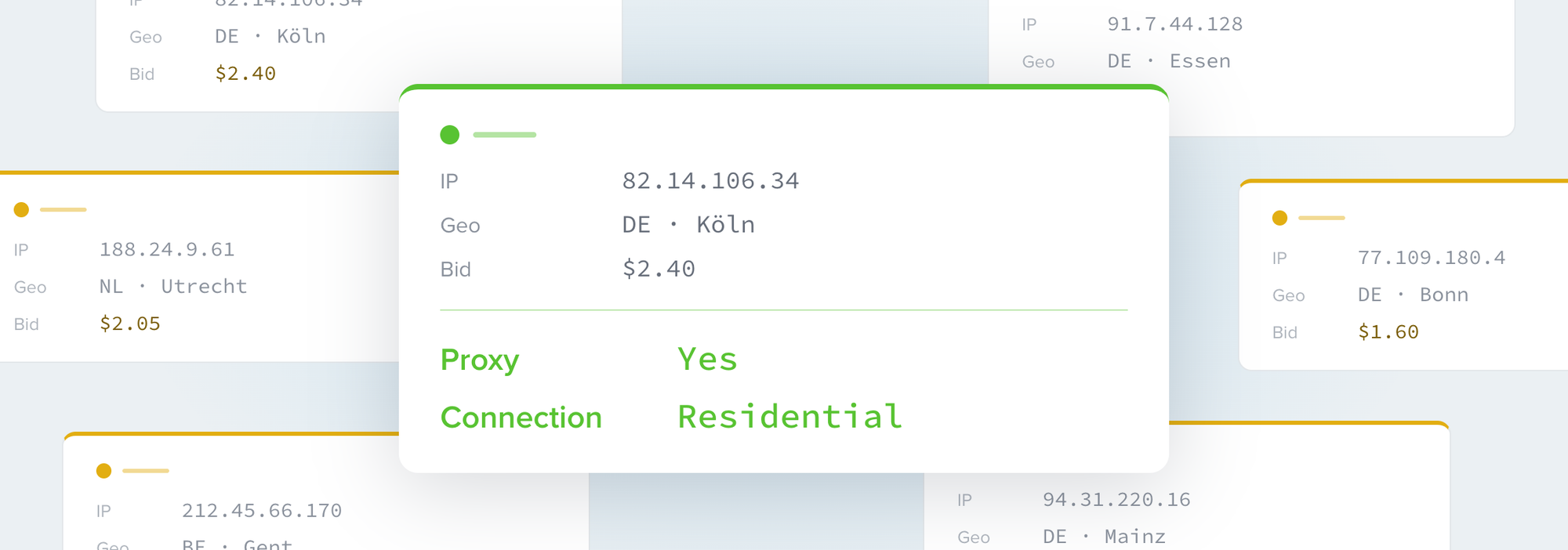
Detect Residential Proxies with IPinfo Max
Get full visibility into residential proxies and anonymizing services, with recency and frequency signals for fraud and security teams.
Get IPinfo MaxResidential proxies are creating a gap in ad fraud detection. For the companies willing to close it, that gap is also a commercial opportunity.
We’ve already had several SSPs and DSPs come to us with a challenge. Even after using ad fraud detection solutions that filter out invalid traffic, we found that between 34% and 55% of IVT was routing through residential proxies. Standard IVT detection methods weren’t catching them.
The ad fraud detection companies that get better at identifying this traffic can catch IVT activity competitors miss, strengthen the fraud detection products it already sells, and give customers another line of defense against invalid traffic, bot traffic, and ad and click fraud.
Residential Proxies in Ad Fraud
Residential proxies have transformed how ad fraud operates because they make IVT and ad fraud look like it is coming from ordinary consumer connections.
That has implications across the advertising ecosystem. Residential proxy networks can be used to generate invalid traffic and fraudulent impressions, simulate engagement with ads, manipulate clicks and conversions, and create traffic that appears to come from desirable geographic markets. All of these waste customer spend. Resproxy networks can also support account creation and other coordinated activity at massive scale.
Since residential proxies route traffic through IPs assigned to consumer and mobile networks, massive bot farms can appear to be legitimate traffic. Rotating through large pools of those addresses also makes activity harder to connect across requests.
The infrastructure behind them is enormous and constantly changing. IPinfo has directly observed more than 100 million residential proxy IP addresses across more than 100 provider networks worldwide. Our research has also found extensive sharing between providers. In one 90-day study, 46% of residential proxy IPs appeared across multiple provider networks simultaneously, while 60% appeared only once during the entire observation period.
For ad fraud detection platforms, the problem is bigger than identifying another type of proxy. Residential proxies give fraudsters a way to exploit the assumptions built into detection methods that expect bot traffic to look different from ordinary consumer traffic.
The traffic samples we’ve seen suggest that gap is already material. When residential proxies can account for more than 50% of traffic that has made it through leading ad fraud filters, there is still a substantial category of IVT for better network context to uncover.
Catching What Others Miss
There are understandable reasons that the fraud detection market is still cautious about implementing radical changes.
Adtech is an ecosystem with strong network effects. Buyers, sellers, verification companies, and platforms all depend on one another. A new detection approach that suddenly classifies substantially more inventory as bot traffic or otherwise fraudulent can create immediate downstream consequences. Publishers may push back. Customers may ask why one vendor is seeing something others are not.
Those pressures can encourage convergence. Being aligned with the rest of the market is easier to defend than being the vendor producing a dramatically different answer.
But that same dynamic makes differentiation more valuable.
A company that can credibly identify a category of fraudulent traffic its competitors are missing has an advantage that can transform their detection as well as the industry at large.
Better residential proxy visibility can strengthen existing ad fraud detection models, improve coverage, support new capabilities, and give sales teams a concrete answer when customers ask what their platform catches that others do not.
The network effects that make companies cautious about moving first can amplify the opportunity for the company that does.
More Than a Proxy Flag
However, residential proxy detection cannot simply become another blocklist.
An IP address appearing in a residential proxy network does not make every connection through that IP invalid traffic or ad fraud. Residential proxy infrastructure changes constantly, IP addresses rotate in and out of provider pools, and the same address can return to ordinary consumer use.
That makes the context around the detection particularly important.
A platform can make a much more informed decision when it knows which residential proxy provider an IP was associated with, how recently it was observed, and how consistently it has appeared over time. An IP observed yesterday and on most days during the past month presents different evidence from an IP observed once several weeks ago.
This is where IPinfo data fits into the fraud detection stack.
Our role is to make that residential proxy activity visible and provide the evidence around it. The ad fraud detection platform can combine those signals with everything else it knows about the impression, device, account, campaign, or transaction and decide how much weight they deserve.
That’s an important distinction. Residential proxy activity is a signal, rather than a fraud verdict. More detailed signals give platforms room to improve fraud detection without treating every residential proxy observation the same way.
The Advantage Is Still Up for Grabs
Residential proxies are already giving fraudsters a way to make sophisticated invalid traffic look like the legitimate traffic adtech platforms process every day. We know some of that traffic is making it through existing detection because DSPs and ad networks are already coming to us to fill the gap themselves.
IPinfo isn't an ad fraud detection company, and we don't need to become one. We provide the underlying network intelligence. Ad fraud detection companies already have the models, customer relationships, and broader view of an impression needed to turn that signal into a fraud decision.
That makes them the natural place for residential proxy detection to live.
There is safety in producing roughly the same answer as everyone else. There is also very little competitive advantage in it. Residential proxy intelligence gives ad fraud companies a chance to identify IVT that competitors are missing and give their customers a capability some are already seeking elsewhere.
Share this article


About the author

Augustin works with top companies in managed detection and response and cybersecurity risk management, helping them deploy IP data solutions that improve responses and enhance intelligence.