


Venue Context in the Bid Request: IPinfo Places for AdTech
Get Unlimited Access to IPinfo Lite
Start using accurate IP data for cybersecurity, compliance, and personalization—no limits, no cost.
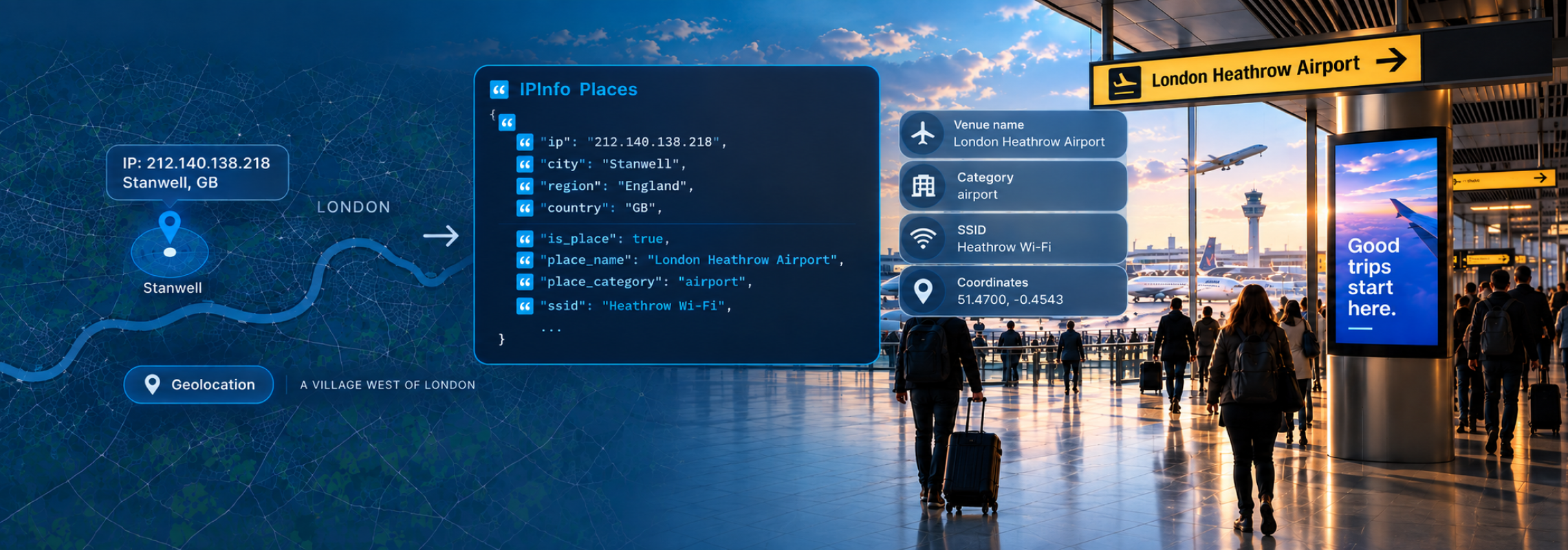
Sign up for freeAn IP in a bid request resolves to Stanwell, a village west of London. IPinfo Places returns London Heathrow Airport, category airport, on the _Heathrow Wi-Fi network. Same request, but now the location carries a travel-intent signal that geolocation alone can’t provide.
That's Places for adtech. Requests coming from public Wi-Fi can carry venue name and category alongside country, city, and DMA.
What Places Puts in the Bid Request
Places is built from observed public Wi-Fi networks. When a device connects at a venue, we match the network to the place operating it. Today that covers about 2.7 million venue IPs in 236 countries across 57 venue categories. Fields include the venue name, its category, the SSID, and coordinates for the building itself.
For a bidder, the category is the field that does the work. "Airport", "hotel", "stadium", "conference center", "retail," and "coffee shop" are segments you can build a line item on today. The venue name becomes useful once you're writing creative for a specific place or joining the record against event data.
What to Expect on Coverage
For one of our customers, an adtech platform selling point-of-interest advertising across MENA, roughly ten percent of daily traffic currently resolves to a tagged venue. Public Wi-Fi is a fraction of any platform's traffic, and our dataset grows as new observations land, so that share will move. It also varies by market, because coverage depends on where we have observed venue networks. The country breakdown on the Places page shows where the dataset is densest today.
Five Ways Places Fits in the Ad Stack
Contextual targeting. On matched traffic, venue context can make an impression more valuable than the same inventory sold generically. A conference center with a trade show running today carries context an advertiser can act on. One adtech platform in MENA built its point-of-interest advertising product on Places, selling venue-targeted inventory to advertisers across its network. They report a 2 to 3x CPM improvement on enriched impressions.
Dynamic creative. The same customer takes the venue name and category off the IP, enriches it against event data, and runs creative against what is happening in that building that day. A conference center provides one kind of context on an ordinary day and something much more specific when a trade show is underway.. Airports work the same way with flight schedules, stadiums with fixture lists.
The next three use cases demonstrate a different feature of employing venue traffic. Thousands of devices sit behind one address at an airport terminal or a stadium. 90.85.9.13 geolocates to Marseille; Places tags it as the CEPAC Vélodrome on the OrangeVelodrome network. On a match night, many devices in the stadium can share that address. Adtech models that treat an IP as roughly equivalent to a household can break down in environments like this.
Frequency capping and reach measurement. A cap keyed on IP treats the terminal as a single user, so it fills almost at once and everyone else behind that address sees nothing. Unique-reach counts run the other way and collapse a full stadium into one person. A venue flag tells the cap to switch keys and the reach count to weigh the address down. Knowing that the IP belongs to a venue gives the model a reason to handle it differently.
Attribution. IP-based footfall or store-visit models can create bad joins when an impression originates from a shared venue IP. A stadium address could represent thousands of unrelated devices, making it a poor identifier for subsequent visits. The venue flag gives attribution models a way to exclude or treat those addresses differently.
Traffic quality. Density-based IVT filters have the same blind spot from the other side. A burst of traffic from one IP looks like a bot cluster until you know it's a departure hall. Venue context helps prevent legitimate high-density traffic from being discarded on density alone.
The last three need only the Places flag. Knowing the request came from shared Wi-Fi is enough, which is why is_place on its own carries weight.
Discover What's Next for Location Targeting in AdTech
Explore how venue-level targeting and IP intelligence are creating new opportunities for advertisers.
Precision Without Identity
Places resolves an IP to the building, so a location that’s otherwise geolocated to a broader part of the city can now carry building-level context.
The Places fields note the network and the venue associated with it. It carries no personal data and says nothing about who is behind the connection, because the observations are aggregated at the network level.
What You Get by Plan
Places is included in IPinfo Core, Plus, and Max, with more venue fields at each level.
Brand, building footprint, BSSIDs, and last-seen date are available for selected use cases. Places is also available for local pre-bid decisioning.
Building an adtech product? Places data can also be integrated into your own platform, product, or decisioning workflow. If you're using Places in a commercial product, talk to our team about commercial licensing. File delivery is also available for workflows that rely on datasets rather than API calls.
To try it against your own traffic, pick a plan and Places will appear in your first lookup. Or find us at DMEXCO on 23 and 24 September, booth A043 in Hall 6.1, and bring a sample.
Share this article


About the author

As the product marketing manager, Fernanda helps customers better understand how IPinfo products can serve their needs.