



Detect Residential Proxies with IPinfo Max
Get full visibility into residential proxies and anonymizing services, with recency and frequency signals for fraud and security teams.
Get IPinfo MaxThe signals available to adtech have changed considerably over the past decade.
Cookies have become less dependable. Mobile advertising IDs are increasingly restricted. Consent requirements have changed what data can move between platforms. At the same time, the traffic flowing through the advertising ecosystem has become more complicated, with bots, VPNs, residential proxies, connected TVs, mobile networks, and other infrastructure making an individual request harder to interpret.
That makes the infrastructure behind the request increasingly useful context for understanding what is happening on the other end.
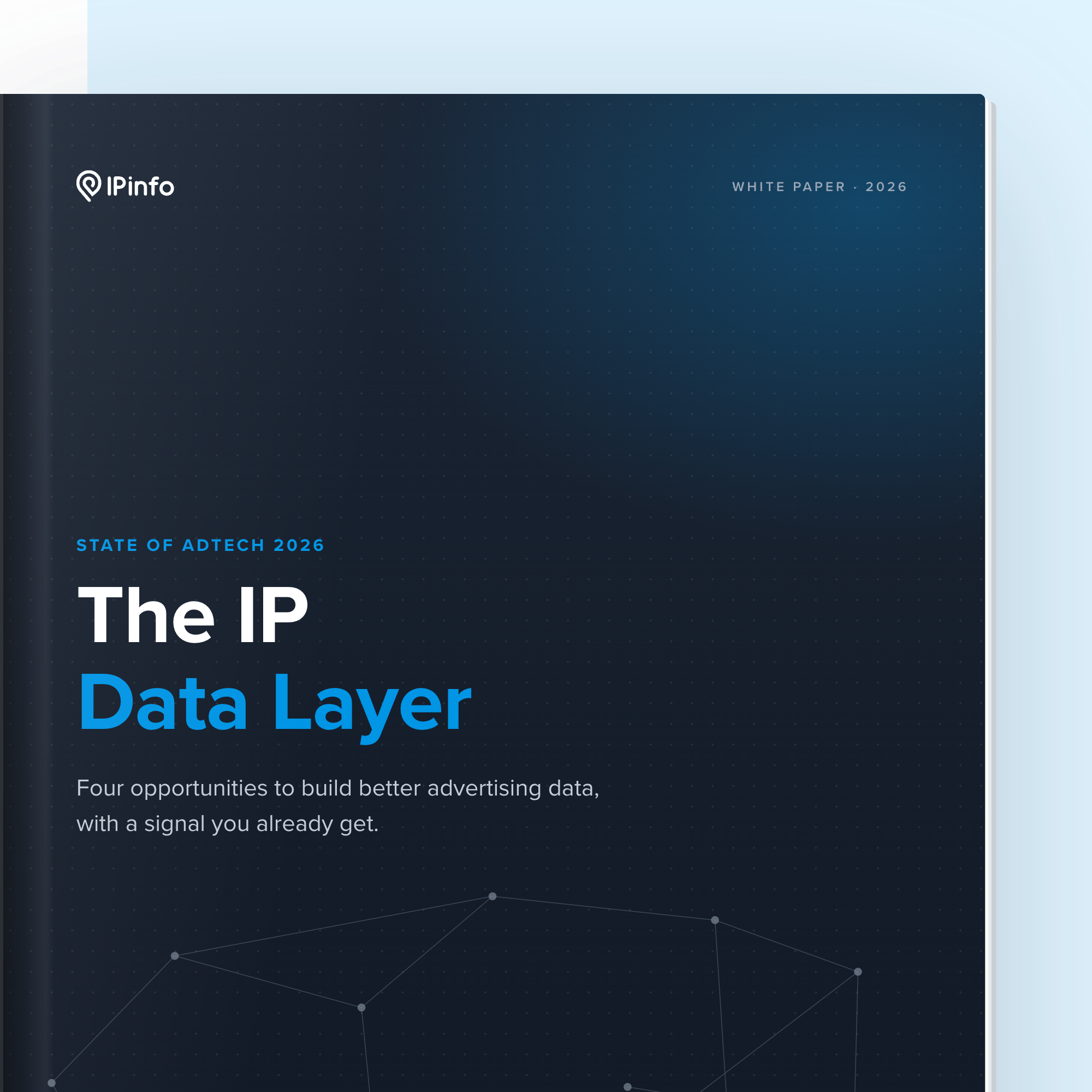
Our new State of AdTech 2026 report looks at that opportunity across the advertising ecosystem. It examines how publishers, SSPs, DSPs, advertisers, measurement companies, and fraud platforms can use IP data to better understand the traffic they already see.
A Shared Signal Across the Advertising Ecosystem
Every participant in an advertising transaction approaches the same traffic with a different question.
A publisher may want to understand whether traffic reaching its inventory is legitimate. An SSP needs to evaluate what it is putting into an auction. A DSP needs enough context to decide what an impression is worth. Advertisers care about where their budgets ultimately go and whether the people, places, and markets they intended to reach match what they bought.
The underlying internet connection can provide useful evidence for all of them.
An IP address can provide context about location, network, carrier, hosting infrastructure, privacy services, residential proxy activity, and even the physical venue associated with some public WiFi connections.
The value comes from applying that context to the decision being made.
Four Opportunities We See Emerging
In the report, we focus on four areas where changes in the advertising ecosystem are making internet data particularly useful:
- Traffic quality: Fraudulent and automated traffic increasingly uses the same residential infrastructure as legitimate users, making the network behind a request an important part of understanding it.
- Verifiable location: Location remains fundamental to advertising, but knowing where an IP is located and knowing how confidently that location can be established are increasingly different questions.
- Context without identity: Network characteristics can tell platforms something useful about a connection without requiring them to identify the individual behind it.
- Places-level context: Public WiFi creates an opportunity to move beyond city-level geography and understand the type of physical environment where a request originates, including airports, hotels, stadiums, conference centers, retail locations, and other venues.
These opportunities share the same underlying idea. IP data becomes more useful when it is treated as context rather than identity.
What the Data Shows
The report also puts these ideas against real advertising traffic.
Our research into residential proxies, for example, found proxy exposure across every sample of verification-filtered advertising traffic we analyzed, in some cases accounting for more than half of the sample. Adding residential proxy detection made roughly 20 times more potentially invalid traffic visible in our analysis.
We also examine what happens when location data is tested rather than simply compared between providers, how network-level signals can add context to an impression, and what venue-level data makes possible for targeting and inventory valuation.
Each points to a broader shift in how internet traffic can be evaluated.
For years, much of adtech has focused on accumulating more identifiers and signals around the person behind a request. There is another layer of information sitting underneath all of that — the infrastructure carrying the request itself.
Read the State of AdTech 2026
The State of AdTech 2026 explores how that infrastructure can help the advertising ecosystem make better decisions about traffic quality, location, targeting, and inventory.
Read the full report to see what IP data reveals about the state of advertising traffic in 2026.
See What IP Data Reveals About AdTech in 2026
Explore the research behind emerging opportunities in traffic quality, verifiable location, and more precise ad targeting.
Share this article


About the author

Meghan is the content strategist at IPinfo, where she develops and writes content for users to better understand the value of IP data and IPinfo products.