


Get Unlimited Access to IPinfo Lite
Start using accurate IP data for cybersecurity, compliance, and personalization—no limits, no cost.
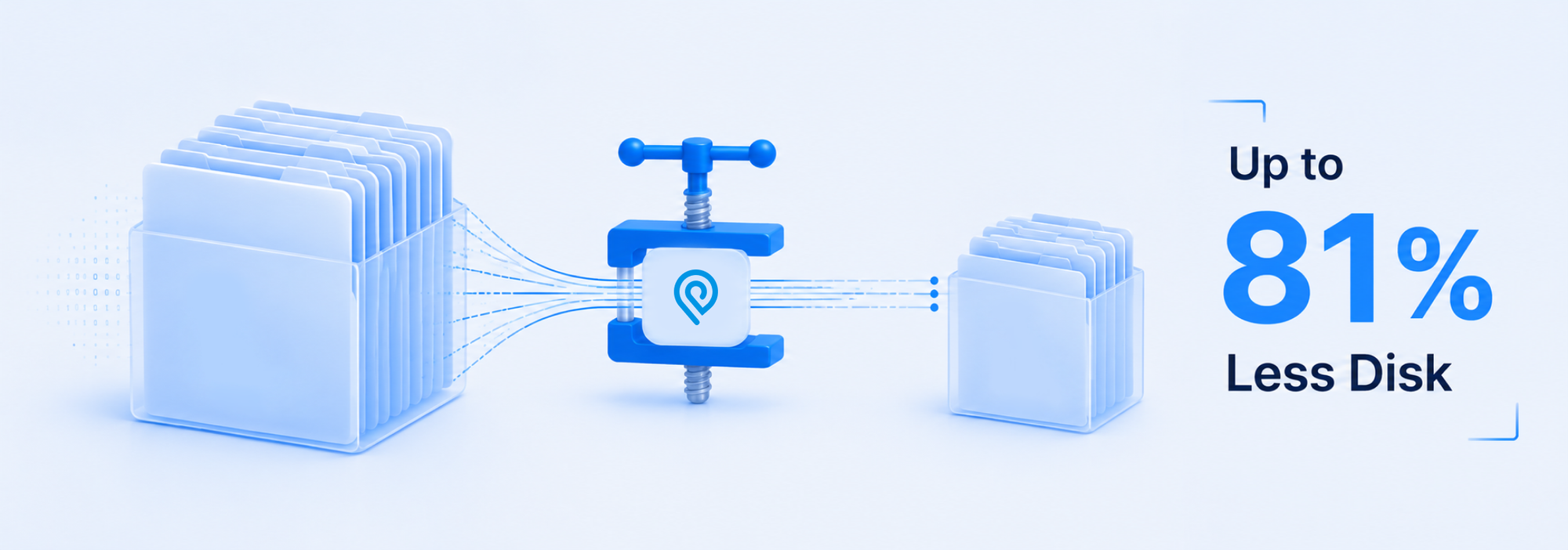
Sign up for freeIf you download IPinfo databases in MMDB format, you may have noticed your files shrinking. Your data is fully intact. The files are smaller because of an optimization we rolled out across all our datasets.
The data inside is byte-for-byte identical, with every network, field, and lookup result preserved. Only the file size has changed, dropping by up to 81% for some datasets, and 32% across our entire catalog.
What Changed
MMDB is the de facto standard for shipping IP data. Its memory-mapped binary search tree answers lookups in microseconds with no external dependencies. It's also famously bulky. File size has always been the trade-off you accept for its speed and simplicity.
Your current integration reads the new files exactly as it did before, with the same format and the same tooling. The only change is a lighter file.
The Numbers
Across the 80 databases we generate daily, the optimization removed 24.4 GB, taking the catalog from 76.9 GB to 52.5 GB, a 32% overall reduction.
Not every dataset shrinks. The gain depends on how repetitive the data is. Datasets where many ranges share the same answer (location, privacy, tags) shrink the most; datasets where every range carries unique values (ASN, organization, WHOIS) were already efficient and stay the same size.
What This Means for You
- Faster downloads, lower ingress. Daily refreshes move a fraction of the bytes, which matters if you pull multi-GB files like Residential Proxy or Plus every day.
- Smaller memory footprint, lower memory costs. MMDB files are memory-mapped, so smaller files mean less RAM on every lookup host. With memory prices having skyrocketed recently, those saved gigabytes translate directly into infrastructure savings.
- Room to grow. Some platforms cap file sizes (a common one is 2 GB). Datasets that were pressing against those limits now fit comfortably, and we have headroom to keep adding IP context without making you re-architect.
- Same or better performance. In our benchmarks, lookup speed is unchanged or slightly improved, since smaller trees mean fewer page faults.
Verified at Every Step
The optimization is lossless and requires no decompression at lookup time. Database contents and lookup results remain unchanged. Before rolling it out, every optimized database passed:
- Full prefix enumeration, with every IP in the original matched against the optimized file in both directions
- Validation with standard MMDB verification tooling, including 12 different MMDB SDKs
- Benchmark parity on lookup latency and memory
The rollout has been live for weeks. Today, 100% of our API traffic and 99.9% of database downloads already serve the optimized files, with the same filenames and delivery you use today.
What's Next
We’ll share the engineering behind the optimization in a forthcoming technical deep dive. That’ll include a closer look at how we reduced MMDB file size while preserving compatibility and lookup performance.
Questions about your specific datasets? Reach out to your account team or support@ipinfo.io.
Share this article


About the author

As the product marketing manager, Fernanda helps customers better understand how IPinfo products can serve their needs.