


Get Unlimited Access to IPinfo Lite
Start using accurate IP data for cybersecurity, compliance, and personalization—no limits, no cost.
Sign up for freeGuest author note: IPXO is a fully automated global platform, enabling businesses to lease and monetize IPv4 addresses securely and efficiently. It connects organizations in need of IP resources with IP holders, creating a self-regulating market that ensures competitive pricing and instant access to IP addresses.
IP reputation is a measure that helps evaluate the quality of an IP address and determine how legitimate its requests are. It enables assessing the source's reputation and separating genuine browsing and transactional behavior from the actions of cybercriminals, hackers, bots, and fraudsters.
Your IP address reputation can directly shape how users experience your website, how your ads perform, and whether your transactions are treated as trustworthy, or flagged as suspicious. A poor reputation creates invisible friction across your business that is easy to miss but hard to undo.
Luckily, it is possible to improve poor IP reputation – it's not static. It can change over time as behavior changes.
How Is IP Reputation Determined?
You could easily compare IP reputation to a credit score. The creditor in this situation is an internet service provider (ISP). The ISP assesses your IP reputation to decide if you should keep sending and receiving requests.
Similarly to a bad credit score, you can gain a bad IP reputation based on past actions that are checked and reviewed to determine your credibility. Internet service providers can attach a bad name to IP addresses based on specific metrics, including:
- Spam traps or honeypots
- High bounce rates
- Spam complaints
- Volume and frequency of outgoing requests
- Association with botnets or malware
- History of serving malicious content
If an IP address has fewer complaints, low bounce rates, and no association with harmful activity, it earns a more positive reputation. However, high volumes of suspicious traffic or flagged behavior – even if unintentional – can quickly push a score in the wrong direction.
IP Reputation: Dedicated vs. Shared IP
It's important to mention the reputation of dedicated IP addresses and shared IP addresses are determined differently.
If you're using a dedicated IP address, your IP reputation is entirely based on how you yourself use it. However, if you're using a shared IP address, the reputation is based on the common activity of all users sharing that same address.
This is especially relevant for businesses using shared hosting or shared infrastructure. If another party on the same IP engages in abusive behavior – scraping, spamming, fraud – your business can be affected too, even if you've done nothing wrong. Checking whether a provider has strong abuse controls in place before committing to a service is always a good idea.
Why Does IP Reputation Matter?
IP reputation affects far more things than one can think. It shapes how users interact with your website, how your paid campaigns perform, and whether your business is seen as trustworthy by security systems and payment providers. In short, it can quietly undermine your operations across multiple channels at once.
Website Access and User Experience
A poor IP reputation can make your website harder to reach or use. Even if everything works on your side, visitors might see a different story.
- Some networks or ISPs may block access completely
- Users might face repeated CAPTCHA checks
- Browsers can flag your site as unsafe or suspicious
- Page load speeds may drop due to filtering or throttling
This kind of friction pushes people away fast and hurts trust before they even explore your offer.
Ads and Tracking Performance
If you run paid campaigns, IP reputation can quietly impact performance. It's not always obvious, but it shows in the results.
- Traffic may be flagged as low-quality or invalid
- Conversion tracking can become less accurate
- Retargeting audiences may shrink or behave oddly
- Ad platforms might limit delivery without clear reasons
You may end up spending the same budget but getting weaker returns.
Fraud and Security Flags
A bad IP history can make your business look risky to security systems and payment providers.
- Transactions may get flagged or declined
- Users might face extra verification steps
- Accounts can be temporarily restricted
- Normal activity may be treated as suspicious
This adds friction at key moments like sign-ups or checkout, where a smooth experience matters most.
One last thing to note is that there is a difference between IP and domain reputation. Domain reputation is tied to the specific domain name itself and persists even as IP addresses change. That said, both are worth monitoring, as either one can undermine your credibility with ISPs, ad platforms, and security systems alike.
How to Check Your IP Reputation
Now that you understand why IP reputation is important, it's time to make sure that you don't have a bad one. You can check your IP address reputation manually or using dedicated tools.
Before you start checking IP addresses, you need to identify the IP address you're using. For email, you can find this in the header section of any sent message, under Sender Policy Framework. For web traffic or ad campaigns, your hosting provider or network admin can typically confirm the relevant IP.
Tools to Check Your IP Reputation
If you're looking for real-time data, it's far easier to check your IP address reputation using dedicated tools. Here are a few you can use to monitor and improve your reputation:
- Google Postmaster Tools reveals your IP address reputation, domain reputation, encryption usage, email authentication rates, and spam rates as seen by Google.
- Microsoft SNDS (Smart Network Data Services) works similarly but is better suited for traffic associated with Outlook. It also detects malware, botnets, spam bots, viruses, and compromised servers.
- Sender Score shows how mailbox providers view your IP using a simple scale from 0 to 100. A score below 70 indicates a bad reputation; 70–80 suggests room for improvement; above 80 is considered excellent.
Note that these tools focus primarily on email-related signals. For broader reputation checks – including web and ad traffic context – tools like IPQualityScore, Spamhaus, or MXToolbox can provide a more complete picture.
How to Improve Your IP Reputation
If you've recently obtained a new IP address with a poor reputation, or you simply have an IP address with that kind of position, it's essential to start fixing existing problems.
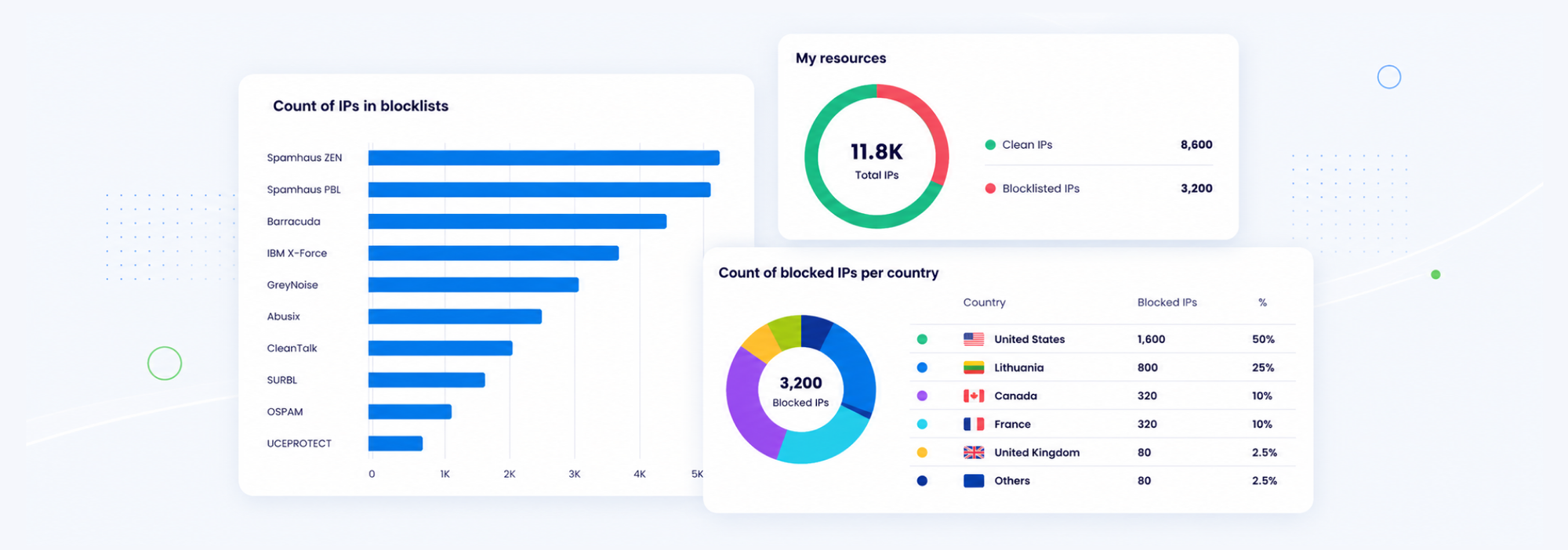
You should also make sure that your IP address is not blocklisted. If your IP is flagged, contact the administrator of that list to learn how to delist it.
To maintain a strong reputation going forward:
- Ensure your servers are free of malware and not part of a botnet
- Monitor your IP regularly with the tools above
- Separate different types of traffic where possible (e.g., transactional vs. marketing emails on separate servers)
- Engage only with users or audiences who have opted in and are likely to respond positively
- Respond quickly if abuse complaints arise – delays make recovery harder
Protecting Your IP Reputation
IP reputation is a metric that matters a lot. It can affect whether users can reach your site, whether your ads perform as expected, and whether your transactions are treated as legitimate. A poor reputation creates friction at every stage of the customer journey, often silently.
Now that you understand how IP reputation works, how it's measured, and how to monitor it, you're in a much better position to protect it. The tools and practices covered in this article are a solid starting point for keeping your score where it needs to be.
Share this article


About the author

Internet Data Expert